Eco-Friendly Cement Mortar with Recycled Olive and Ceramic Waste
DOI:
https://doi.org/10.31272/mjmes.v1i1.3Keywords:
Aggregates, Ceramic, Mortar, Olive Stone, Tile, Waste Materials, Compressive strength, Thermal conductivityAbstract
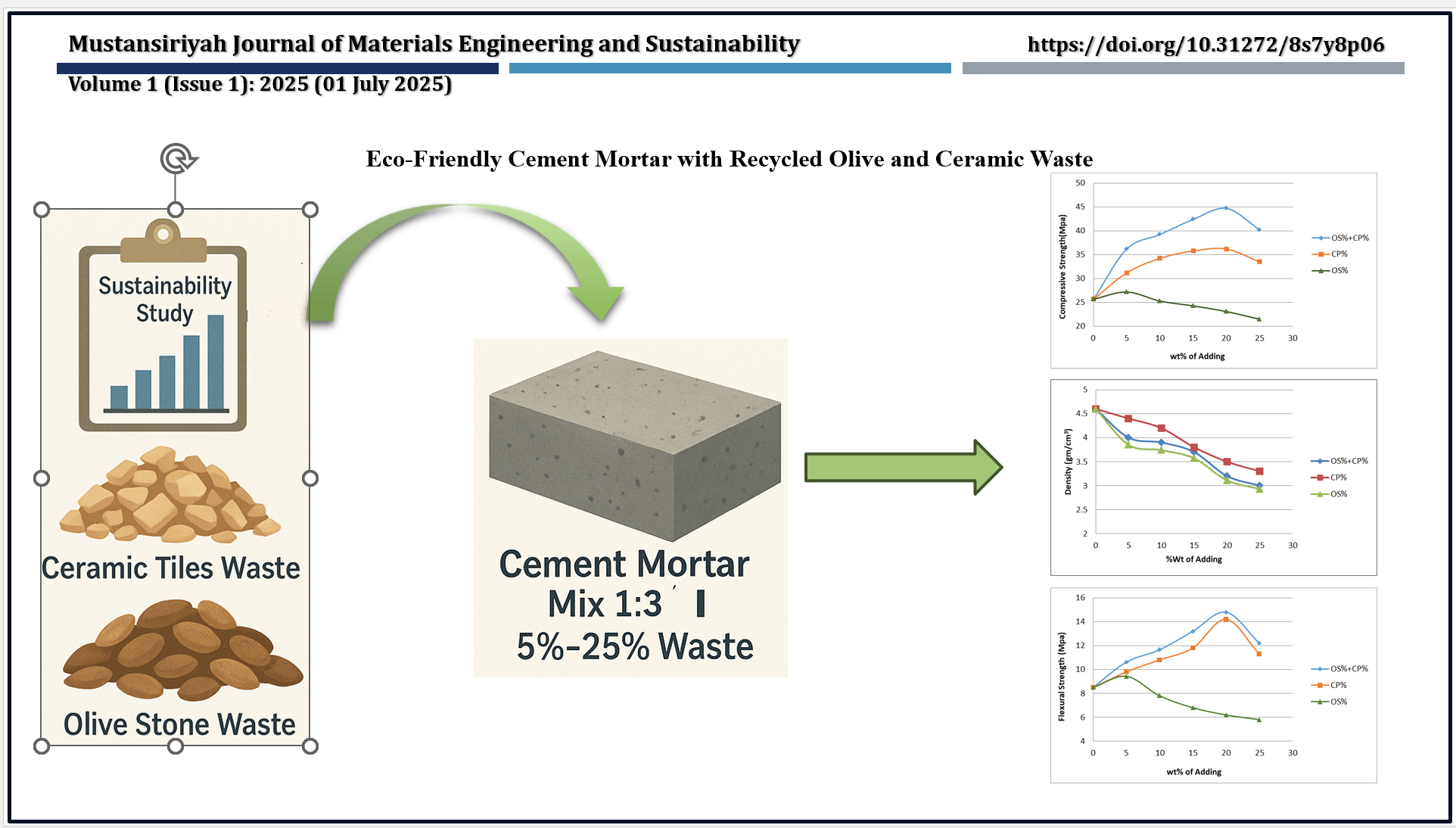
The disposal of ceramic tiles from demolished buildings and olive stone waste has contributed to significant environmental challenges. Enhancing their reuse and recycling potential is crucial for sustainable solid waste management. This study investigates the viability of partially substituting fine aggregates in cement mortar using a mixture of olive stone (a natural waste) along with ceramic powder derived from wall tiles (an industrial waste). Thermal and mechanical properties were analyzed to assess performance. In addition to promoting environmentally friendly materials that improve buildings' energy efficiency, recycling construction debris helps reduce landfill accumulation. To assess the effect on material qualities, specimens of cement mortar were made using a 1:3 mix ratio and a 0.5 W/C ratio, with the addition of 5% to 25% of these waste materials. The inclusion of a superplasticizer improved workability and compressive strength. Various ratios were tested for thermal conductivity, flexural strength, density, as well as compressive strength. According to the results, the best performance was achieved when ceramic powder and olive stone accounted for 20% of the fine aggregate, increasing compressive strength by 54% as well as flexural strength by 67%, while thermal insulation improved by 25% at 28 days. This study validates the practicality of integrating olive along with ceramic waste to improve the insulating characteristics along with the mechanical characteristics of cement mortar.
Downloads
Downloads
Published
Issue
Section
Categories
License
Copyright (c) 2025 Dalia Adil, Manolia Abed Al-Wahab Ali, Manal Hamed Jasem, Balsam Mahmood Shaker (Author)

This work is licensed under a Creative Commons Attribution-ShareAlike 4.0 International License.
Open Access and Copyright
MJMES follows an open-access publishing model, ensuring that all published articles are freely accessible to a global audience without any subscription or payment barriers. Every article is distributed under the Creative Commons Attribution International Public License (CC BY 4.0), which grants broad rights to individuals and institutions, allowing them to:
- Download, share, and distribute full-text articles without restrictions.
- Print, reproduce, or link to published content in any format or medium.
Although copyright ownership remains with the authors, MJMES actively promotes their work by facilitating citation tracking and visibility, thereby enhancing the impact and recognition of published research. The CC BY 4.0 license is designed to maximize the reach and reuse of scholarly publications while ensuring that appropriate credit is always attributed to the original authors.
How to Cite