Experimental Investigation of the Mechanical, Physical, and Microstructural Performance of Cement Boards Reinforced with Hybrid and PVA Fibers
DOI:
https://doi.org/10.31272/mjmes.v2i1.16Keywords:
Hybrid, Poly vinyl fiber, SEM, Density, Setting TimeAbstract
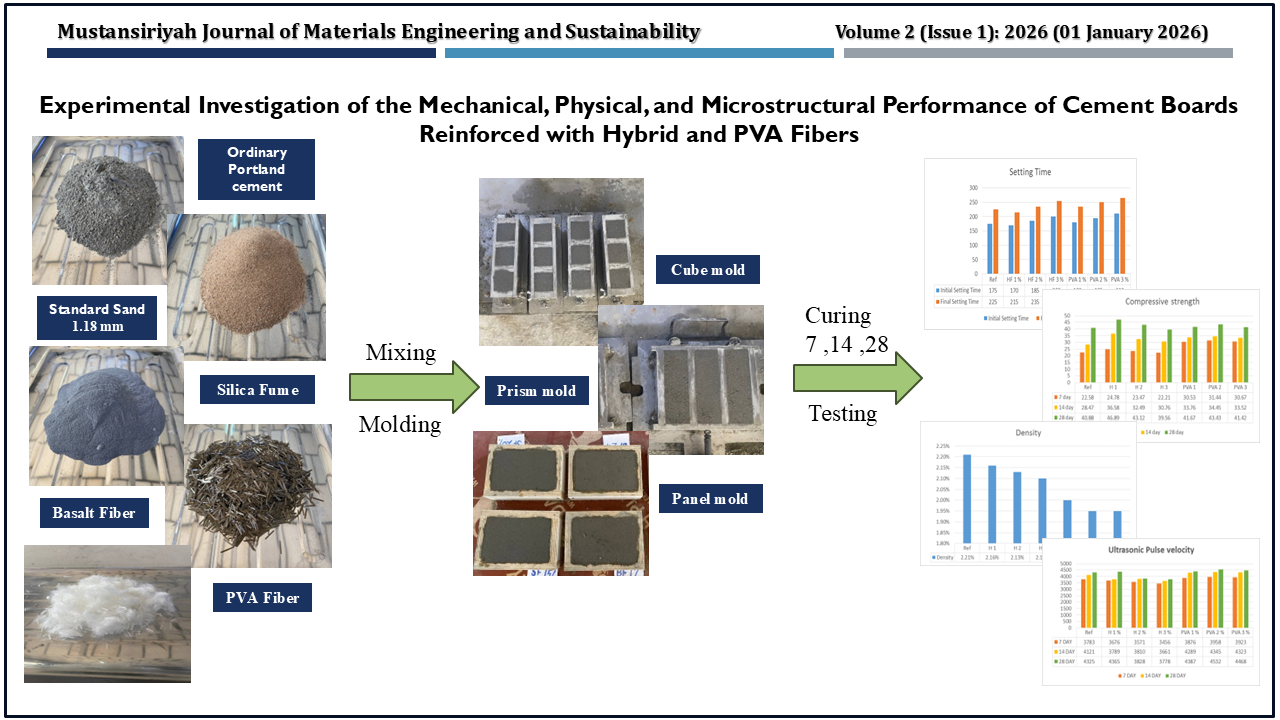
This study explores the combined influence of hybrid fibers (HF) and polyvinyl alcohol (PVA) fibers on the structural and physical performance of fumed-silica cement boards. Scanning electron microscopy (SEM) was employed to analyze mortar mixtures containing different fiber proportions and to assess improvements in their microstructure. The experimental program included tests for compressive strength, stiffness, density, ultrasonic pulse velocity, and setting time. Findings show that incorporating 1% hybrid fibers yields the best mechanical performance, achieving a compressive strength of 46.89 MPa and a stiffness of 99.34, along with a 2.16% reduction in density compared to the reference mix. A mixture with 2% PVA fibers also enhances compressive strength (43.4 MPa) and stiffness, while higher fiber content generally leads to longer setting times. SEM observations revealed effective crack-bridging and thickening of the base matrix. Overall, the results indicate that the combination of 1% HF fibers and 2% PVA fibers represents the optimal formulation in terms of strength, durability, and rigidity, supporting the development of more advanced and high-performance cement boards.
Downloads
References
[1] R. Mukhametrakhimov and L. Lukmanova, "The modified fiber cement panels for civil construction," in Energy Management of Municipal Transportation Facilities and Transport: Springer, 2017, pp. 852-858. DOI: https://doi.org/10.1007/978-3-319-70987-1_91
[2] M. Lee, G.-K. Park, S.-W. Kim, and H.-G. Kwak, "Damage characteristics of high-performance fiber-reinforced cement composites panels subjected to projectile impact," International Journal of Mechanical Sciences, vol. 214, p. 106919, 2022. DOI: https://doi.org/10.1016/j.ijmecsci.2021.106919
[3] A. Enfedaque, D. Cendón, F. Gálvez, and V. Sánchez-Gálvez, "Failure and impact behavior of facade panels made of glass fiber reinforced cement (GRC)," Engineering Failure Analysis, vol. 18, no. 7, pp. 1652-1663, 2011. DOI: https://doi.org/10.1016/j.engfailanal.2011.01.004
[4] M. Monazami and R. Gupta, "Investigation of mechanical behavior and fracture energy of fiber-reinforced concrete beams and panels," Cement and Concrete Composites, vol. 133, p. 104656, 2022. DOI: https://doi.org/10.1016/j.cemconcomp.2022.104656
[5] K. F. Hasan, P. G. Horváth, and T. Alpár, "Development of lignocellulosic fiber reinforced cement composite panels using semi-dry technology," Cellulose, vol. 28, no. 6, pp. 3631-3645, 2021. DOI: https://doi.org/10.1007/s10570-021-03755-4
[6] A. A. Moyet, K. M. Owaid, and R. M. Raouf, "Investigating the Effects of Micro Montmorillonite on Cement Mortar Physical Properties," COMMUNICATIONS, vol. 26, no. 4, pp. D122-D133, 2024. DOI: https://doi.org/10.26552/com.C.2024.053
[7] T. Robl, R. Jewell, T. Duvallet, E. Gülcan, R. Rathbone, and A. Oberlink, "The Determination of Pozzolanic Activity: Comparison of ASTM and EN Strength Activity Methods and Electrical Resistivity," Advances in Civil Engineering Materials, vol. 11, no. 2, pp. 520-538, 2022. DOI: https://doi.org/10.1520/ACEM20210159
[8] P. Gleize, A. Müller, and H. Roman, "Microstructural investigation of a silica fume–cement–lime mortar," Cement and Concrete composites, vol. 25, no. 2, pp. 171-175, 2003. DOI: https://doi.org/10.1016/S0958-9465(02)00006-9
[9] A. Frýbort, J. Štulířová, J. Grošek, and M. Gregerova, "Changes in the chemical composition of silica fume in the concrete composite system," Case Studies in Construction Materials, vol. 18, p. e01916, 2023. DOI: https://doi.org/10.1016/j.cscm.2023.e01916
[10] A. Grigoryan, "Improvement of the Cement Mortar Characteristics Reinforced with Basalt Fibers," Journal of Architectural and Engineering Research, vol. 8, pp. 12-21, 2025. DOI: https://doi.org/10.54338/27382656-2025.8-02
[11] S. J. S. Allah, M. M. Kassim, and G. A. Salman, "The durability of concrete mortars with different mineral additives exposed to sulfate attack," Salud, Ciencia y Tecnología-Serie De Conferencias, no. 3, p. 851, 2024. DOI: https://doi.org/10.56294/sctconf2024851
[12] P. Zhang, X. Han, Y. Zheng, J. Wan, and D. Hui, "Effect of PVA fiber on mechanical properties of fly ash-based geopolymer concrete," Reviews on Advanced Materials Science, vol. 60, no. 1, pp. 418-437, 2021. DOI: https://doi.org/10.1515/rams-2021-0039
[13] I. Sakurada, Polyvinyl alcohol fibers. CRC Press, 1985.
[14] M. Konkanov, T. Salem, P. Jiao, R. Niyazbekova, and N. Lajnef, "Environment-friendly, self-sensing concrete blended with byproduct wastes," Sensors, vol. 20, no. 7, p. 1925, 2020. DOI: https://doi.org/10.3390/s20071925
[15] B. A. Abdelsalam, M. A. Saad, M. Amin, and I. S. Agwa, "Flexural performance of concrete beams reinforced with fiber ropes as partial sustainable reinforcement," Innovative Infrastructure Solutions, vol. 10, no. 9, pp. 1-15, 2025. DOI: https://doi.org/10.1007/s41062-025-02223-3
[16] B. Akhondi and A. Hojatkashani, "Investigation on the Effect of Addition of Nano Alumina, Nano-silica, Nano Titania, and Mwcnts on Flexural and Compressive Strengths of Cement Mortar," AUT Journal of Civil Engineering, vol. 4, no. 4, pp. 487-504, 2020.
[17] M. Şahmaran and V. C. Li, "Influence of microcracking on water absorption and sorptivity of ECC," Materials and structures, vol. 42, no. 5, pp. 593-603, 2009. DOI: https://doi.org/10.1617/s11527-008-9406-6
[18] M. Kharseh, F. Moutassem, K. Alamara, and I. Awad, "Artificial neural networks-based ultrasonic pulse velocity prediction model for concrete structures," Cogent Engineering, vol. 11, no. 1, p. 2428969, 2024. DOI: https://doi.org/10.1080/23311916.2024.2428969
[19] W. G. A. Hussein, A. Al-Sultan, and F. Al-Ani, "Acoustic and thermal insulation properties of recycled aggregate mortar," in IOP Conference Series: Materials Science and Engineering, 2021, vol. 1067, no. 1: IOP Publishing, p. 012022. DOI: https://doi.org/10.1088/1757-899X/1067/1/012022
[20] M. Cao, Z. Liu, and C. Xie, "Effect of steel-PVA hybrid fibers on compressive behavior of CaCO3 whiskers reinforced cement mortar," Journal of Building Engineering, vol. 31, p. 101314, 2020. DOI: https://doi.org/10.1016/j.jobe.2020.101314
[21] J. Udebunu, H. Abdolpour, and Ł. Sadowski, "Comprehensive experimental investigation of the mechanical properties and performance enhancement of polyvinyl alcohol fiber-reinforced cement mortar," Archives of Civil and Mechanical Engineering, vol. 25, no. 1, p. 58, 2024. DOI: https://doi.org/10.1007/s43452-024-01113-2
[22] M. Cao, L. Xu, and C. Zhang, "Rheological and mechanical properties of hybrid fiber reinforced cement mortar," Construction and Building Materials, vol. 171, pp. 736-742, 2018. DOI: https://doi.org/10.1016/j.conbuildmat.2017.09.054
[23] B. N. Al-Kharabsheh et al., "Basalt fiber reinforced concrete: A compressive review on durability aspects," Materials, vol. 16, no. 1, p. 429, 2023. DOI: https://doi.org/10.3390/ma16010429
[24] A. M. Neville, Properties of concrete. Longman London, 1995.
[25] B. N. Al-Kharabsheh et al., "Basalt fiber reinforced concrete: A compressive review on durability aspects," Materials, vol. 16, no. 1, p. 429, 2023 DOI: https://doi.org/10.3390/ma16010429
[26] Y. Lin, K. Shih-Fang, C. Hsiao, and L. Chao-Peng, "Investigation of pulse velocity-strength relationship of hardened concrete," ACI Materials Journal, vol. 104, no. 4, p. 344, 2007. DOI: https://doi.org/10.14359/18823
[27] S. Hedjazi and D. Castillo, "Relationships among compressive strength and UPV of concrete reinforced with different types of fibers," Heliyon, vol. 6, no. 3, 2020. DOI: https://doi.org/10.1016/j.heliyon.2020.e03646
[28] M. Ziada, S. Erdem, Y. Tammam, S. Kara, and R. A. G. Lezcano, "The effect of basalt fiber on mechanical, microstructural, and high-temperature properties of fly ash-based and basalt powder waste-filled sustainable geopolymer mortar," Sustainability, vol. 13, no. 22, p. 12610, 2021. DOI: https://doi.org/10.3390/su132212610
[29] M. Durmaz, "Synergistic Effects of Steel Fibers and Silica Fume on Concrete Exposed to High Temperatures and Gamma Radiation," Buildings, vol. 15, no. 11, p. 1830, 2025 DOI: https://doi.org/10.3390/buildings15111830
[30] A. Grigoryan, "Improvement of the Cement Mortar Characteristics Reinforced with Basalt Fibers," Journal of Architectural and Engineering Research, vol. 8, pp. 12-21, 2025. DOI: https://doi.org/10.54338/27382656-2025.8-02
[31] A. Imam, V. Kumar, and V. Srivastava, "Review study towards effect of Silica Fume on the fresh and hardened properties of concrete," Advances in concrete construction, vol. 6, no. 2, p. 145, 2018.
[32] H. Zeng, J. Zhang, Y. Li, X. Su, C. Gu, and K. Zhang, "Mechanical properties and microstructure of basalt fiber reinforced concrete under the single-side salt-freezing–drying–wetting cycles," International Journal of Concrete Structures and Materials, vol. 16, no. 1, p. 44, 2022. DOI: https://doi.org/10.1186/s40069-022-00535-7
[33] S. Yao, C. Hu, F. Wang, and S. Hu, "Improving the interfacial properties of PVA fiber and cementitious composite: Design and characterization," Construction and Building Materials, vol. 409, p. 134163, 2023. DOI: https://doi.org/10.1016/j.conbuildmat.2023.134163
[34] H. Li, H.-g. Xiao, J. Yuan, and J. Ou, "Microstructure of cement mortar with nano-particles," Composites part B: engineering, vol. 35, no. 2, pp. 185-189, 2004. DOI: https://doi.org/10.1016/S1359-8368(03)00052-0
[35] D. Sikarskas, V. Antonovič, J. Malaiškienė, R. Boris, R. Stonys, and G. Šahmenko, "Modification of the structure and properties of lightweight cement composite with PVA fibers," Materials, vol. 14, no. 20, p. 5983, 2021. DOI: https://doi.org/10.3390/ma14205983
[36] J. Li et al., "Experimental investigation on interfacial bonding performance between cluster basalt fiber and cement mortar," Construction and Building Materials, vol. 411, p. 134215, 2024. DOI: https://doi.org/10.1016/j.conbuildmat.2023.134215
[37] L. Hong, Y. Chen, T. Li, P. Gao, and L. Sun, "Microstructure and bonding behavior of fiber-mortar interface in fiber-reinforced concrete," Construction and Building Materials, vol. 232, p. 117235, 2020. DOI: https://doi.org/10.1016/j.conbuildmat.2019.117235
Downloads
Published
Data Availability Statement
All data generated or analyzed during this study are included in this published article
Issue
Section
Categories
License
Copyright (c) 2026 Shukran H. Faraj, Mohammed J. Kadhim (Author)

This work is licensed under a Creative Commons Attribution-ShareAlike 4.0 International License.
Open Access and Copyright
MJMES follows an open-access publishing model, ensuring that all published articles are freely accessible to a global audience without any subscription or payment barriers. Every article is distributed under the Creative Commons Attribution International Public License (CC BY 4.0), which grants broad rights to individuals and institutions, allowing them to:
- Download, share, and distribute full-text articles without restrictions.
- Print, reproduce, or link to published content in any format or medium.
Although copyright ownership remains with the authors, MJMES actively promotes their work by facilitating citation tracking and visibility, thereby enhancing the impact and recognition of published research. The CC BY 4.0 license is designed to maximize the reach and reuse of scholarly publications while ensuring that appropriate credit is always attributed to the original authors.
How to Cite