Influence of Ply Arrangement on Failure Criteria in Fibre-Reinforced Composite Laminates using ACP Pre-Simulation, Numerical Assessment
DOI:
https://doi.org/10.31272/mjmes.v2i1.10Keywords:
Carbon/Epoxy Composite, Explicit Dynamic modules in ANSYS , ACP, compoaiteAbstract
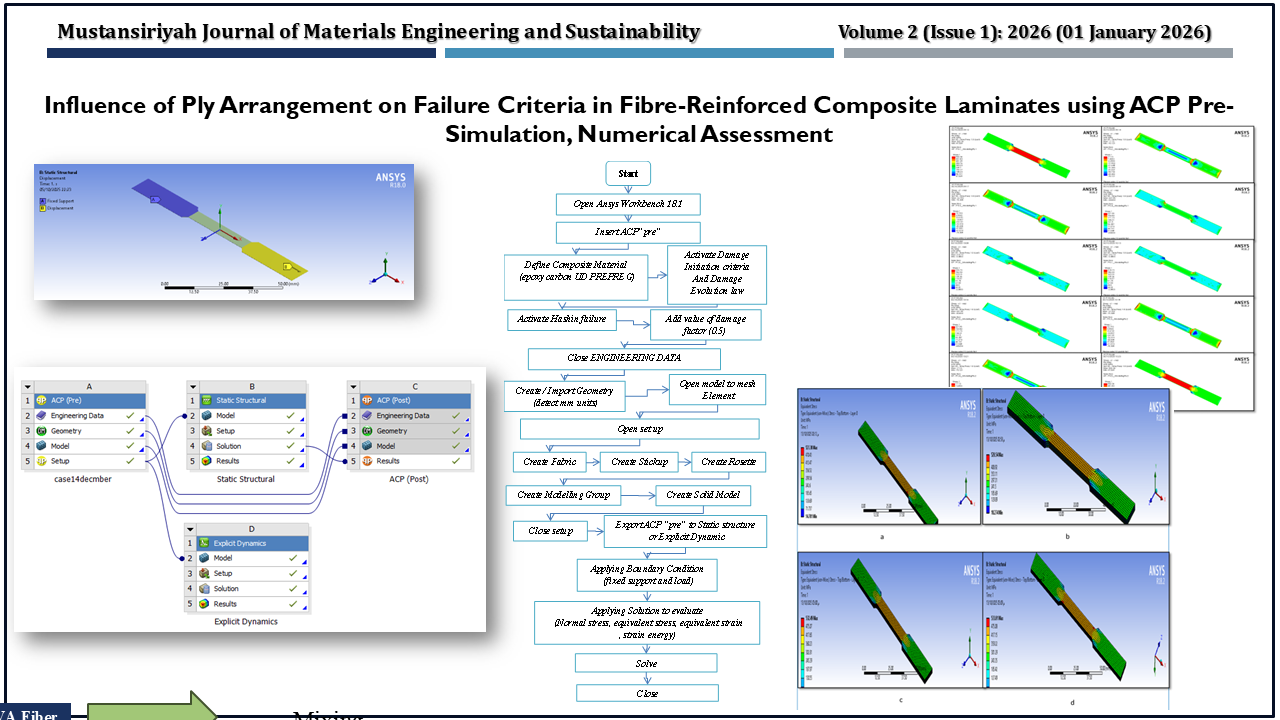
Fiber-reinforced composites (FRCs) are among the most widely used materials in modern engineering applications due to their high mechanical properties and light weight. The current study involved a numerical investigation conducted through experimental a validation process using ANSYS Workbench R18.0 to evaluate the mechanical behavior and failure mechanism of (Carbon/Epoxy UD Prepreg). The modelling process was initiated using ACP-PRE to crate four types of laminate structures: balanced cross ply, symmetric, and random. The current model demonstrated an acceptable range of reliability and accuracy to investigate different laminate structures, with a validation error percentage of less than 8% and 13% for both static and explicit analysis. From the study, it has been concluded that the cross-ply layer structure has the highest ultimate stress, reaching 1911.2 MPa, while the random laminate structure has almost 80% in tensile strength reduction. A 700 MPa ultimate tensile stress was obtained for the cross-ply type, although the balanced laminate exhibited a weaker load response, 30 % lower than the cross-ply. Moreover, the laminate configuration of cross-ply stands as the best option in terms of reverse factor, which indicates a value of 6.7, and the highest energy of strain reached 1.5123 with 46% higher safety margin. As a result, this configuration is suggested to be the best combination and capability for the safety structure and energy absorption. These findings highlight the critical role of ply arrangement in enhancing the mechanical integrity of composite structures and support the need for deliberate design strategies in laminate engineering. Moreover, the current paper suggests ACP Pre (Advanced Composite Pre-processor) as an effective tool for simulating composite materials with layered structures.
Downloads
References
[1] A. P. Singh, M. Sharma, and I. Singh, "A review of modeling and control during drilling of fiber reinforced plastic composites," Composites Part B: Engineering, vol. 47, no. April, pp. 118-125, 2013, doi: https://doi.org/10.1016/j.compositesb.2012.10.038. DOI: https://doi.org/10.1016/j.compositesb.2012.10.038
[2] T. N. Abdalla, A. F. Hasan, and A. N. Jasim, "Investigation of using hybrid reinforcement filler on the mechanical and electrical properties of high-density polyethylene (HDPE) composite," AIP Conference Proceedings, vol. 1, no. 1, p. 060014, 2024, doi: https://doi.org/10.1063/5.0212385. DOI: https://doi.org/10.1063/5.0212385
[3] A. K. Tayyeh and A. F. Hasan, " Morphological, and Corrosion Study of 316L Stainless Steel Coated With Hydroxyapatite, Chitosan, Nano‐MgO, and 3‐Aminopropyl Trimethoxysilane via Electrophoretic Deposition," Journal of Nanotechnology, vol. 1, no. 1, p. 2865104, 2025. DOI: https://doi.org/10.1155/jnt/2865104
[4] N. A. Saad, M. Hamzah, and A. F. Hamzah, "Numerical and experimental investigation for tensile properties of polyphenylene sulfide basis composite material," Babylon Univ, vol. 10, no. 1, pp. 1-22, 2014.
[5] R. Vijayanandh, N. Kumar, and N. Kumar, "Material optimization of high speed micro aerial vehicle using FSI simulation," Procedia Computer Science, vol. 133, no. 1, pp. 2-9, 2018, doi: https://doi.org/10.1016/j.procs.2018.07.002. DOI: https://doi.org/10.1016/j.procs.2018.07.002
[6] L. Alonso, C. Navarro, and S. K. García-Castillo, "Analytical models for the perforation of thick and thin thickness woven-laminates subjected to high-velocity impact," Composites Part B: Engineering, vol. 143, no. June, pp. 292-300, 2018, doi: https://doi.org/10.1016/j.compositesb.2018.01.030. DOI: https://doi.org/10.1016/j.compositesb.2018.01.030
[7] G. Tong and T. F. Liu, "Finite element analysis of woven fabric laminates structural strength," Advanced Materials Research, vol. 785, no. 1, pp. 199-203, 2013, doi: https://doi.org/10.4028/www.scientific.net/AMR.785-786.199. DOI: https://doi.org/10.4028/www.scientific.net/AMR.785-786.199
[8] B. Duleba, Ľ. Dulebová, and E. Spišák, "Simulation and evaluation of carbon/epoxy composite systems using FEM and tensile test," Procedia Engineering, vol. 96, no. 1, pp. 70-74, 2014, doi: https://doi.org/10.1016/j.proeng.2014.12.099. DOI: https://doi.org/10.1016/j.proeng.2014.12.099
[9] G. Qi, S. Du, B. Zhang, and Y. Yu, "A new approach to assessing carbon fiber/epoxy interfacial shear strength by tensile test of 45 fiber bundle composites: experiment, modeling and applicability," Composites Science and Technology, vol. 129, no. June, pp. 214-221, 2016, doi: https://doi.org/10.1016/j.compscitech.2016.04.032. DOI: https://doi.org/10.1016/j.compscitech.2016.04.032
[10] R. Vijayanandh, K. Venkatesan, M. Ramesh, G. Raj Kumar, and M. Senthil Kumar, "Optimization of orientation of carbon fiber reinforced polymer based on structural analysis," International Journal of Scientific & Technology Research, vol. 8, no. 11, pp. 3020-3029, 2019.
[11] M. Žmindák, P. Novak, J. Soukup, D. Milosavljevic, and M. Kaco, "Finite element simulation of tensile test of composite materials manufactured by 3D printing," in IOP Conference Series: Materials Science and Engineering, Liptovský Ján, Slovakia, 2020, vol. 776, no. 1: IOP Publishing, p. 012082, doi: https://doi.org/10.1088/1757-899X/776/1/012082. DOI: https://doi.org/10.1088/1757-899X/776/1/012082
[12] D. K. Rajak, P. H. Wagh, H. Moustabchir, and C. I. Pruncu, "Improving the tensile and flexural properties of reinforced epoxy composites by using cobalt filled and carbon/glass fiber," Forces in Mechanics, vol. 4, no. October, p. 100029, 2021, doi: https://doi.org/10.1016/j.finmec.2021.100029. DOI: https://doi.org/10.1016/j.finmec.2021.100029
[13] P. Maneendra, K. G. Reddy, K. L. Kumar, C. Rajesh, and D. Saibabu, "Determination And Analysis of Tensile Strength for Epoxy Refined Coconut Fiber Composite with Rice Hulls and Sawdust as Refinements," International Journal of Mechanical Engineering, vol. 7, no. 4, pp. 1716-1719, 2022.
[14] X. Luo, X. Huang, K. P. Baxevanakis, P. S. Karamched, and V. V. Silberschmidt, "Interaction of propagating crack with microstructure in CGI: In situ tensile test and numerical simulation," Materials Science and Engineering: A, vol. 918, no. December, p. 147431, 2024, doi: https://doi.org/10.1016/j.msea.2024.147431. DOI: https://doi.org/10.1016/j.msea.2024.147431
[15] E. Szpoganicz et al., "Effect of prepreg ply thickness and orientation on tensile properties and damage onset in carbon-fiber composites for cryogenic environments," Composite Structures, vol. 359, no. April, p. 118996, 2025, doi: https://doi.org/10.1016/j.compstruct.2025.118996. DOI: https://doi.org/10.1016/j.compstruct.2025.118996
[16] G. A. Kebede and G. R. Gutata, "Characterizing tensile and flexural properties of synthetic fibers-reinforced epoxy composite for foot prosthetic application," Heliyon, vol. 10, no. 19, p. e38471, 2024, doi: https://doi.org/10.1016/j.heliyon.2024.e38471. DOI: https://doi.org/10.1016/j.heliyon.2024.e38471
[17] A. Asthana et al., "Development and mechanical properties evaluation of environmentally sustainable composite material using various reinforcements with epoxy," Case Studies in Construction Materials, vol. 21, p. e03624, 2024. DOI: https://doi.org/10.1016/j.cscm.2024.e03624
[18] G. Czél, "Development of sandwich test coupons with continuous protective layers for accurate determination of the tensile failure strain of unidirectional carbon fibre reinforced composites," Composites Part A: Applied Science and Manufacturing, vol. 187, no. December, p. 108440, 2024, doi: https://doi.org/10.1016/j.compositesa.2024.108440. DOI: https://doi.org/10.1016/j.compositesa.2024.108440
[19] G.-q. Yu, Y.-r. Ren, T.-t. Zhang, W.-s. Xiao, and H.-y. Jiang, "Hashin failure theory based damage assessment methodology of composite tidal turbine blades and implications for the blade design," China Ocean Engineering, vol. 32, no. 2, pp. 216-225, 2018, doi: https://doi.org/10.1007/s13344-018-0023-z. DOI: https://doi.org/10.1007/s13344-018-0023-z
[20] G. Raj Kumar, M. Senthil Kumar, R. Vijayanandh, K. Raja Sekar, K. Mohamed Bak, and S. Varun, "The Mechanical Characterization of Carbon Fiber Reinforced Epoxy with Carbon Nanotubes,," International Journal of Mechanical and Production Engineering Research and Development, vol. 9, no. 1, pp. 243-255, 2019.
[21] R. M. Jones, Taylor and francis, 2nd ed. (Mechanics of Composite Materials). New York: CRC Press, 1999, p. 538.
[22] A. A. Shaikh, A. A. Pradhan, A. M. Kotasthane, S. S. Patil, and S. Karuppanan, "Finite Element Analysis of Mechanical Properties of Basalt-Carbon Epoxy Hybrid Laminates," Mechanics of Advanced Composite Structures, vol. 9, no. 2, pp. 263-274, 2022, doi: https://doi.org/10.22075/macs.2022.25300.1370.
[23] R. K. Rajamanickam, R. Durvasulu, and S. Moorthi, "Investigation on mechanical properties of carbon fiber composite using FEM for leaf spring applications," Journal of Aerospace Technology and Management, vol. 14, no. 1, p. e0322, 2022, doi: https://doi.org/10.1590/jatm.v14.1244. DOI: https://doi.org/10.1590/jatm.v14.1244
[24] I. M. Daniel and O. Ishai, Engineering mechanics of composite materials, 2nd ed. New York: Oxford University Press, 1994, p. 411.
[25] Z. Hashin, "Fatigue Failure Criteria for Unidirectional Fiber Composites," Journal of Applied Mechanics, vol. 48, no. 4, pp. 846-852, 1981, doi: https://doi.org/10.1115/1.3157744. DOI: https://doi.org/10.1115/1.3157744
Downloads
Published
Issue
Section
Categories
License
Copyright (c) 2026 Zainab Jasim Mahmood, Ahmed F. Hasan (Author)

This work is licensed under a Creative Commons Attribution-ShareAlike 4.0 International License.
Open Access and Copyright
MJMES follows an open-access publishing model, ensuring that all published articles are freely accessible to a global audience without any subscription or payment barriers. Every article is distributed under the Creative Commons Attribution International Public License (CC BY 4.0), which grants broad rights to individuals and institutions, allowing them to:
- Download, share, and distribute full-text articles without restrictions.
- Print, reproduce, or link to published content in any format or medium.
Although copyright ownership remains with the authors, MJMES actively promotes their work by facilitating citation tracking and visibility, thereby enhancing the impact and recognition of published research. The CC BY 4.0 license is designed to maximize the reach and reuse of scholarly publications while ensuring that appropriate credit is always attributed to the original authors.
How to Cite