A Green and Sustainable Approach for Corrosion Inhibition of Carbon Steel in HCl Solution by Abelmoschus Esculentus Peduncle Extract
DOI:
https://doi.org/10.31272/mjmes.v2i1.20Keywords:
Corrosion Inhibition, Carbon Steel, Abelmoschus esculentus, Green Inhibitor, HCl, Adsorption Isotherm, Weight LossAbstract
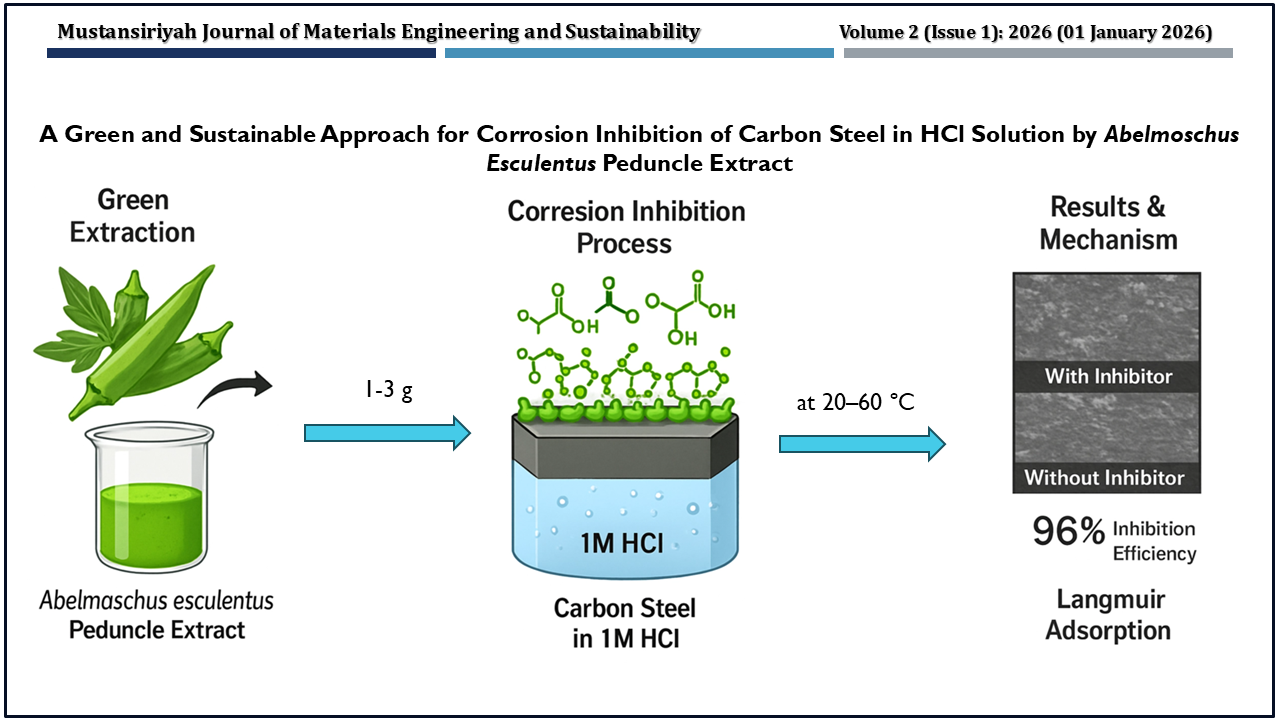
The corrosion of carbon steel in hydrochloric acid (HCl) is a major economic and safety problem in industrial processes such as pickling and descaling. This research investigates the use of peduncle extract from Abelmoschus esculentus (okra) as a green, ecological corrosion inhibitor. A structured literature review indicates that okra extracts, particularly mucilage, can achieve high inhibition efficiencies (up to 96%) by adsorbing onto carbon steel surfaces, predominantly following the Langmuir adsorption isotherm. Experimentally, weight loss measurements were performed on carbon steel in 1 M HCl with varying concentrations of okra peduncle extract (1–3) g at 20–60 °C. Results showed high inhibition efficiency (up to 98.4% at 40 °C for 3 g extract), which was concentration-dependent and exhibited a slight decrease at 60°C (90.7%). Thermodynamic analysis indicated a spontaneous physisorption process. The synthesized evidence confirms that Abelmoschus esculentus peduncle extract is a potent, sustainable, and economically viable alternative to traditional synthetic corrosion inhibitors.
Downloads
References
[1] Koch, G.H., et al., Corrosion cost and preventive strategies in the United States. 2002, United States. Federal Highway Administration.
[2] Joseph, O., et al. Global and economic effects of corrosion-An overview. in AIP Conference Proceedings. 2022. AIP Publishing LLC.DOI: https://doi.org/10.1063/5.0092286. DOI: https://doi.org/10.1063/5.0092286
[3] Maanonen, M., Steel pickling in challenging conditions. 2014, Helsinki Metropolia University of Applied Sciences. p. 32 pages + 3 appendices.
[4] Avdeev, Y.G. and Y.I. Kuznetsov, Nitrogen-containing five-membered heterocyclic compounds as corrosion inhibitors for metals in solutions of mineral acids-An overview. International Journal of Corrosion and Scale Inhibition, 2021. 10(2): p. 480-540.DOI: doi: 10.17675/2305-6894-2020-10-2-2. DOI: https://doi.org/10.17675/2305-6894-2020-10-2-2
[5] Raja, P.B. and M.G. Sethuraman, Natural products as corrosion inhibitor for metals in corrosive media—a review. Materials letters, 2008. 62(1): p. 113-116.DOI: https://doi.org/10.1016/j.matlet.2007.04.079. DOI: https://doi.org/10.1016/j.matlet.2007.04.079
[6] Hossain, N., M. Asaduzzaman Chowdhury, and M. Kchaou, An overview of green corrosion inhibitors for sustainable and environment friendly industrial development. Journal of Adhesion Science and Technology, 2021. 35(7): p. 673-690.DOI: https://doi.org/10.1080/01694243.2020.1816793. DOI: https://doi.org/10.1080/01694243.2020.1816793
[7] Bandeira, R.M., et al., The green plant-based corrosion inhibitors—a sustainable strategy for corrosion protection. Surface Science and Technology, 2025. 3(1): p. 19.DOI: https://doi.org/10.1007/s44251-025-00084-7. DOI: https://doi.org/10.1007/s44251-025-00084-7
[8] Buchweishaija, J., Phytochemicals as green corrosion inhibitors in various corrosive media: a review. Tanzania Journal of Science, 2009. 35.DOI: https://doi.org/10.4314/tjs.v35i1.
[9] Gemede, H.F., et al., Nutritional quality and health benefits of okra (Abelmoschus esculentus): A review. J Food Process Technol, 2015. 6(458): p. 2. DOI: https://doi.org/10.4172/2157-7110.1000458
[10] Uwiringiyimana, T., et al., Review on Okra (Abelmoschus esculentus (L.) Moench) Production, Nutrition and Health Benefits. Rwanda Journal of Agricultural Sciences, 2024. 3(1): p. 71-87.DOI: https://www.ajol.info/index.php/rjeas/article/view/266776.
[11] Sulaimon, A.A., et al., Analysis of natural okra extracts as corrosion inhibitors for mild steel in acidic medium. Environmental Science and Pollution Research, 2023. 30(56): p. 119309-119328.DOI: https://doi.org/10.1007/s11356-023-30635-0. DOI: https://doi.org/10.1007/s11356-023-30635-0
[12] Sulaimon, A.A., et al., Quantitative and qualitative analyses of grafted okra for corrosion inhibition of mild steel in acidic medium. Frontiers in Chemistry, 2023. 11: p. 1129673.DOI: https://doi.org/10.3389/fchem.2023.1129673. DOI: https://doi.org/10.3389/fchem.2023.1129673
[13] Abd-El-Nabey, B., et al., Eco-friendly corrosion inhibition of steel in acid pickling using Prunus domestica Seeds and Okra stems extracts. International Journal of Electrochemical Science, 2024. 19(8): p. 100695.DOI: https://doi.org/10.1016/j.ijoes.2024.100695. DOI: https://doi.org/10.1016/j.ijoes.2024.100695
[14] Miralrio, A. and A. Espinoza Vázquez, Plant extracts as green corrosion inhibitors for different metal surfaces and corrosive media: a review. Processes, 2020. 8(8): p. 942.DOI: https://doi.org/10.3390/pr8080942. DOI: https://doi.org/10.3390/pr8080942
[15] Hussein, S.A. and A.A. Khadom, Okra leaves extract as green corrosion inhibitor for steel in sulfuric acid: Gravimetric, electrochemical, and surface morphological investigations. Results in Chemistry, 2024. 8: p. 101566.DOI: https://doi.org/10.1016/j.rechem.2024.101566. DOI: https://doi.org/10.1016/j.rechem.2024.101566
[16] Ormanli, E., et al., Development and characterization of films based on okra polysaccharides and whey protein isolate. Journal of Food Measurement and Characterization, 2023. 17(1): p. 264-277.DOI: https://doi.org/10.1007/s11694-022-01598-6. DOI: https://doi.org/10.1007/s11694-022-01598-6
[17] Abdulkhaleq, L.G., The inhibitive effect of eucalyptus camaldulenis leaves extract on the corrosion of low carbon steel in hydrochloric acid. Journal of engineering and sustainable development, 2013. 17(3): p. 169-185.DOI: https://jeasd.uomustansiriyah.edu.iq/index.php/jeasd/article/view/1009.
[18] Adil, D., et al., Eco-Friendly Cement Mortar with Recycled Olive and Ceramic Waste. Mustansiriyah Journal of Materials Engineering and Sustainability, 2025. 1(1): p. 07-12.DOI: https://doi.org/10.31272/mjmes.v1i1.3. DOI: https://doi.org/10.31272/mjmes.v1i1.3
[19] Orubite, K. and N. Oforka, Inhibition of the corrosion of mild steel in hydrochloric acid solutions by the extracts of leaves of Nypa fruticans Wurmb. Materials letters, 2004. 58(11): p. 1768-1772.DOI: https://doi.org/10.1016/j.matlet.2003.11.030. DOI: https://doi.org/10.1016/j.matlet.2003.11.030
[20] Ghalib, L., H.J.M. Al Jaaf, and H.A. Abdulghani, Temperature effect on the efficiency of Eucalyptus Camaldulensis leaves in the acid corrosion of carbon steel. Materials Today: Proceedings, 2021. 42: p. 2475-2481.DOI: https://doi.org/10.1016/j.matpr.2020.12.566. DOI: https://doi.org/10.1016/j.matpr.2020.12.566
[21] Ghalib, L., H.A. Abdulghani, and A.J. Hamad. A comparative study on inhibitory action of Ficus carica, Olea europaea and Ziziphus spina-christi plant leaves on carbon steel in sulfuric acid medium. in AIP Conference Proceedings. 2020. AIP Publishing LLC.DOI: https://doi.org/10.1063/5.0000249. DOI: https://doi.org/10.1063/5.0000249
Downloads
Published
Data Availability Statement
The datasets generated during and/or analyzed during the current study are available from the corresponding author on reasonable request.
Issue
Section
Categories
License
Copyright (c) 2026 Lubna Ghalib, Baydaa Jaber Nabhan, Amina Kassim Hussain, Shaukat Ali Mazari (Author)

This work is licensed under a Creative Commons Attribution-ShareAlike 4.0 International License.
Open Access and Copyright
MJMES follows an open-access publishing model, ensuring that all published articles are freely accessible to a global audience without any subscription or payment barriers. Every article is distributed under the Creative Commons Attribution International Public License (CC BY 4.0), which grants broad rights to individuals and institutions, allowing them to:
- Download, share, and distribute full-text articles without restrictions.
- Print, reproduce, or link to published content in any format or medium.
Although copyright ownership remains with the authors, MJMES actively promotes their work by facilitating citation tracking and visibility, thereby enhancing the impact and recognition of published research. The CC BY 4.0 license is designed to maximize the reach and reuse of scholarly publications while ensuring that appropriate credit is always attributed to the original authors.
How to Cite