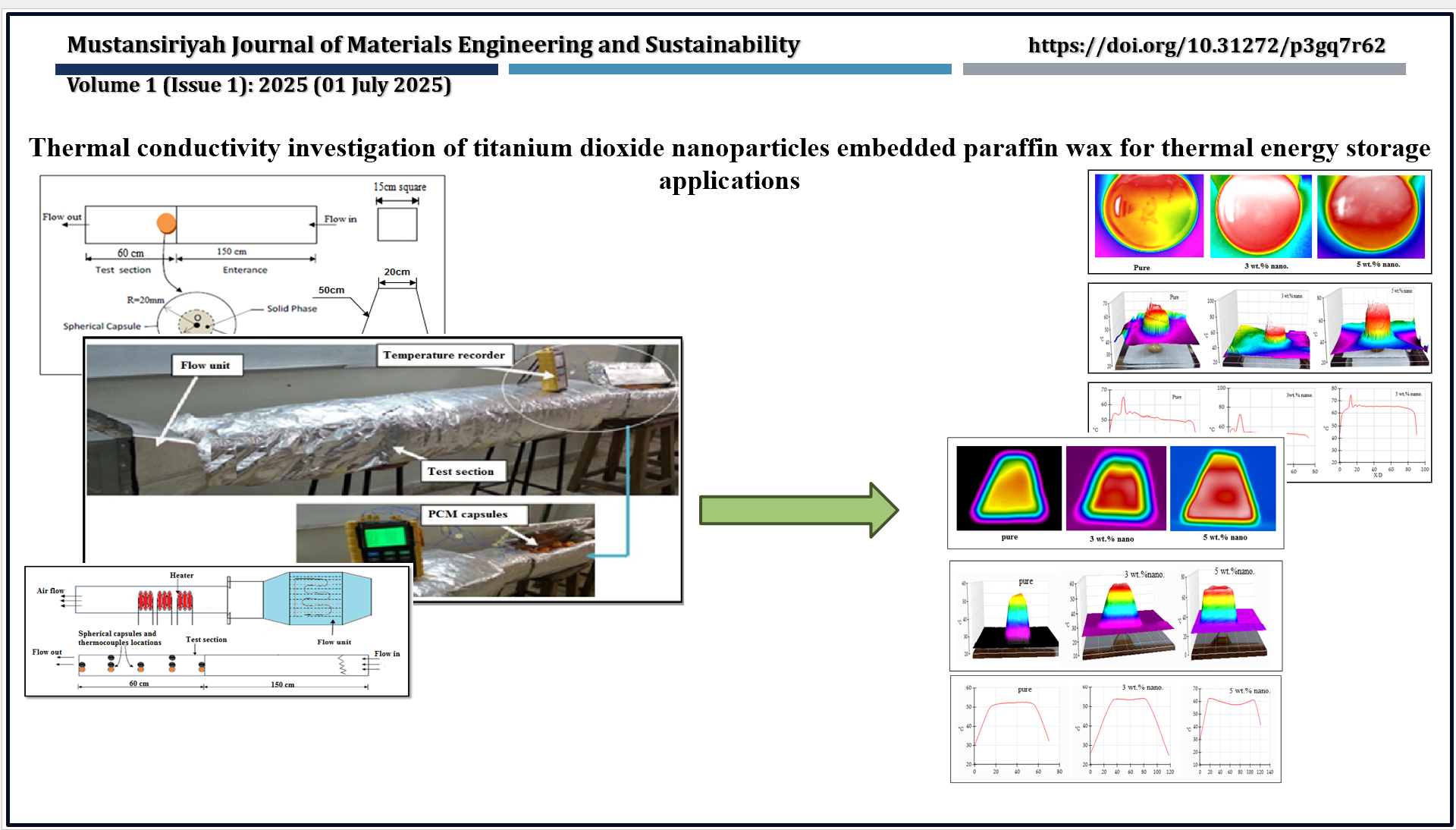
Thermal conductivity investigation of titanium dioxide nanoparticles embedded paraffin wax for thermal energy storage applications
DOI:
https://doi.org/10.31272/mjmes.v1i1.4Keywords:
Phase change materials, Thermal conductivity, paraffin wax, Titanium dioxide, nanoparticlesAbstract
To enhance the efficacy of thermal conversion systems, it is imperative to incorporate them with thermal energy storage mechanisms. Within the extensive selection of essential materials, phase change materials (PCMs) are identified as the top choice for the retention and later liberation of thermal energy, attributable to their notable latent heat of fusion. Generally, PCMs exhibit low thermal conductivity. Incorporating nano additives has been explored to improve the thermal characteristics of PCMs further. In our recent exploration, we augmented the thermal conductivity of paraffin wax using different mass concentration additions (1 wt. %, 3 wt. %, 5 wt. Titanium dioxide (TiO2) nanoparticles exist at a percentage that is roughly 10 nm in diameter. Researchers have noted that introducing TiO2 nanoparticles into the paraffin wax matrix affects the temperature at which phase changes occur. Also, the thermal conductivity in the resultant composites indicated a falling tendency as temperature increased, due to the increased surface interfacial thermal resistance between TiO2 nanoparticles and the wax matrix. A notable enhancement in thermal conductivity, quantified at approximately 10% and 7%, was recorded through the utilisation of spherical and trapezoidal capsules, respectively, at a nanoparticle loading of 5 wt. The atmospheric conditions are 50±5% humidity and the temp is at 15°C.
Downloads
Downloads
Published
Issue
Section
Categories
License
Copyright (c) 2025 Baydaa Jaber Nabhan, Lubna Ghalib, Shaukat Ali Mazari (Author)

This work is licensed under a Creative Commons Attribution-ShareAlike 4.0 International License.
Open Access and Copyright
MJMES follows an open-access publishing model, ensuring that all published articles are freely accessible to a global audience without any subscription or payment barriers. Every article is distributed under the Creative Commons Attribution International Public License (CC BY 4.0), which grants broad rights to individuals and institutions, allowing them to:
- Download, share, and distribute full-text articles without restrictions.
- Print, reproduce, or link to published content in any format or medium.
Although copyright ownership remains with the authors, MJMES actively promotes their work by facilitating citation tracking and visibility, thereby enhancing the impact and recognition of published research. The CC BY 4.0 license is designed to maximize the reach and reuse of scholarly publications while ensuring that appropriate credit is always attributed to the original authors.
How to Cite