Analyze Thermal Installation in Buildings for Different Insulations and Thicknesses Using Computational Fluid Dynamic
DOI:
https://doi.org/10.31272/mjmes.v1i1.2Keywords:
Natural Convection, Thermal Conductivity, Turbulent, Numerical Analysis, Correlation of Optimum Thickness, Computational Fluid DynamicsAbstract
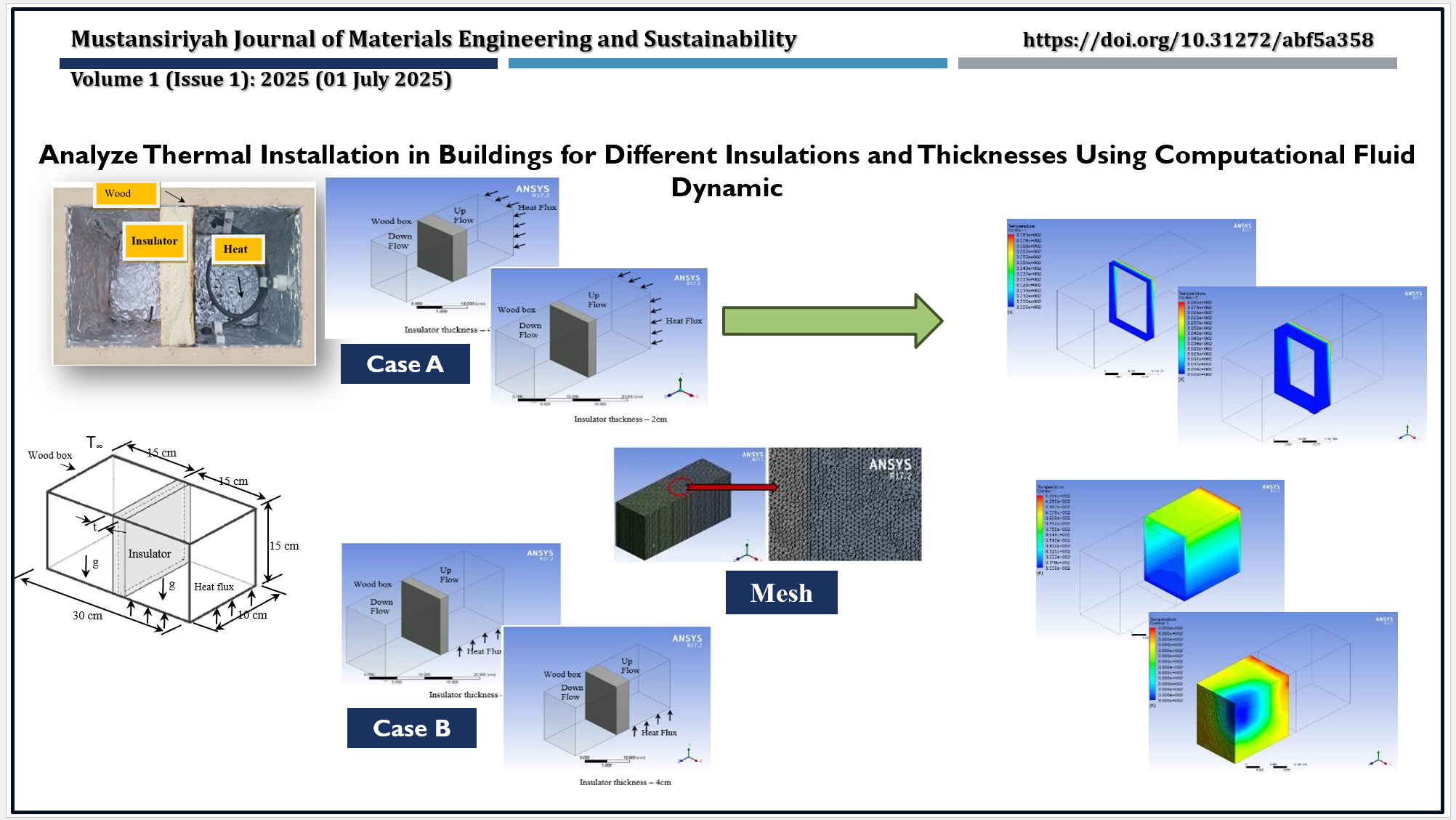
The purpose of thermal insulation is to reduce the rate of heat transfer. The goal of this work is to investigate the impact of various insulator species that can be utilized to increase thermal insulation. In the present investigation, natural heat transfer investigations are accomplished with a wooden box enclosure and four insulating materials with different thermal conductivity and two thicknesses of 2 cm and 4 cm for each piece. Four pieces of insulating material are PE foam, Polyisocyanurate, Polystyrene (XPS 300) and wood that is each piece attached in the middle space of the wooden test cell to achieve two parts up and down flow region. The experimental work is done with heat flux (350,500 and 650W/m2) and Ra numbers ranging from (2.19×10⁵ to 1.30×10⁶). Also, the wooden test cell is simulated using computational fluid dynamics by using 3D Fluent Ansys software program version 17.2 for temperature distribution through insulation and enclosure with heat flux (500 W/m2) and Ra numbers ranging from (2.19×10⁵ to 1.30×10⁶). The results are shown when there is a reduction in insulator conductivity, so a decrease in the heat transfer through the box walls results in preferable thermal insulation for the box. The relationship between thermal conductivity (k) and the optimum thickness of various insulation materials (topt) is investigated with a polynomial non-linear correlation. This correlation will be particularly useful in estimating the ideal thickness of insulators for minimizing heat transfer meanwhile an insulation material based solely on its thermal conductivity.
Downloads
Downloads
Published
Issue
Section
Categories
License
Copyright (c) 2025 Afreen Emad Sa’ad-Aldeen, Salwa Ahmad Sarow (Author)

This work is licensed under a Creative Commons Attribution-ShareAlike 4.0 International License.
Open Access and Copyright
MJMES follows an open-access publishing model, ensuring that all published articles are freely accessible to a global audience without any subscription or payment barriers. Every article is distributed under the Creative Commons Attribution International Public License (CC BY 4.0), which grants broad rights to individuals and institutions, allowing them to:
- Download, share, and distribute full-text articles without restrictions.
- Print, reproduce, or link to published content in any format or medium.
Although copyright ownership remains with the authors, MJMES actively promotes their work by facilitating citation tracking and visibility, thereby enhancing the impact and recognition of published research. The CC BY 4.0 license is designed to maximize the reach and reuse of scholarly publications while ensuring that appropriate credit is always attributed to the original authors.
How to Cite