A Comprehensive Review of Natural and Industrial Waste Recycling in Concrete Production
DOI:
https://doi.org/10.31272/mjmes.v2i1.21Keywords:
Alternative Aggregates, Environmental Impact, Recycled Ceramic Waste, Resource Conservation, Sustainable Concrete, Waste GlassAbstract
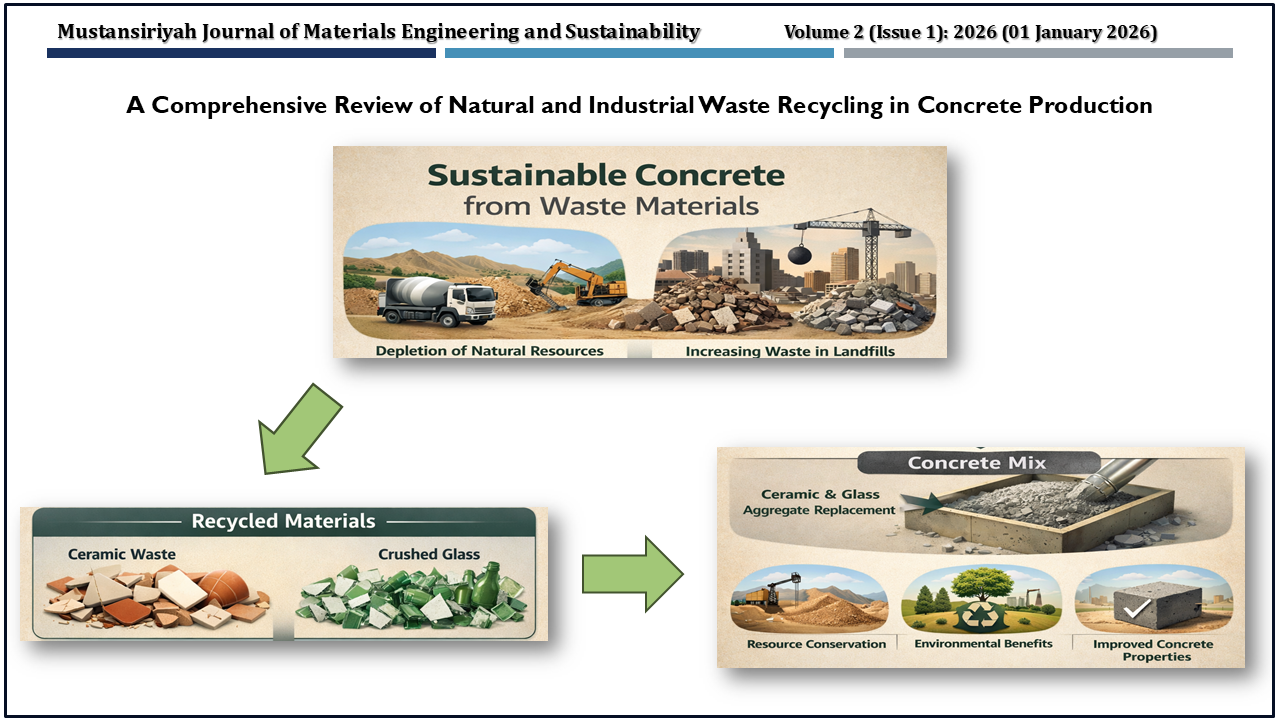
Concrete is still the most common building material used across the globe, but the extensive production of concrete has put tremendous pressure on natural resources, including river sand and crushed stone. At the same time, the rapid expansion of both construction and manufacturing industries has led to an increased amount of solid waste generated, specifically from ceramic debris and waste glass due to either demolition or industrial processes. Many of these types of waste materials are deposited into landfills, which adds to the degradation of our environment as well as presents challenges in their disposal. In response to this issue, recent research has expanded significantly in terms of utilizing recycled ceramic and glass waste in the development of concrete mixtures, as a means of creating a more sustainable alternative to traditional fine and coarse aggregate. The purpose of this study was to demonstrate the viability of using ceramic waste and crushed glass as a partial replacement for conventional aggregates and how these two types of waste materials affect concrete's mechanical, physical, and durability properties. The goal of using ceramic waste and crushed glass is to reduce the need for extracting natural resources, limit the negative environmental impacts from the accumulation of waste in landfills, and promote sustainable construction practices. The results of this study will provide additional insight into the performance of concrete produced with ceramic waste and glass waste and how these types of materials can help to create a more sustainable construction material.
Downloads
References
[1] M. Safiuddin, M. Z. Jumaat, M. Salam, M. Islam, and R. Hashim, “Utilised solid wastes in construction materials,” International Journal of Physical Sciences, vol. 5, issue 13, pp. 1952–1963, 2010. https://academicjournals.org/journal/IJPS/article-.
[2] O. M. Okeyinka, D. A. Oloke, and J. M. Khatib, “A Review on Recycled Use of Solid Wastes in Building Materials,” World Academy of Science, Engineering and Technology: International Journal of Civil and Environmental Engineering, vol. 9, issue 12, pp. 1570–1579, 2015. https://www.academia.edu/download/77653016/pdf.pdf
[3] US Environmental Protection Agency, Municipal Solid Waste Landfills, Research Triangle Park, North Carolina, USA, 2014.
[4] S. I. Durowaye, G. I. Lawal, O. I. Sekunowo, and E. G. Okonkwo, “Synthesis and characterisation of hybrid polyethylene terephthalate matrix composites reinforced with Entada Mannii fiber particles and almond shell particles,” Journal of King Saud University – Engineering Sciences, vol. 31, issue 4, pp. 305–313, 2019. DOI: 10.1016/j.jksues.2017.09.006. DOI: https://doi.org/10.1016/j.jksues.2017.09.006
[5] D. A. Rasool, M. A. Abdulkarem, and M. A. Abdulrehman, “The Effect of Adding Recycled Waste on the Mechanical Properties of Concrete,” Defect and Diffusion Forum, vol. 398, pp. 83–89, 2020. DOI: 10.4028/www.scientific.net/DDF.398. DOI: https://doi.org/10.4028/www.scientific.net/DDF.398.83
[6] M. Y. Abdulwahid, Effect of Olive Waste Ash on the Mechanical Properties of Mortar, M.Sc. Thesis, Jordan University of Science and Technology, 2009.
[7] N. M. Al-Akhras and M. Y. Abdulwahid, “Utilisation of olive waste ash in mortar mixes,” Structural Concrete, vol. 11, issue 4, pp. 221–228, 2010. DOI: 10.1680/stco.2010.11.4.221. DOI: https://doi.org/10.1680/stco.2010.11.4.221
[8] A. Eisa, “Properties of Concrete Incorporating Recycled Post-Consumer Environmental Wastes,” International Journal of Concrete Structures and Materials, vol. 8, issue 3, pp. 251–258, 2014. DOI: 10.1007/s40069-013-0065-9. DOI: https://doi.org/10.1007/s40069-013-0065-9
[9] S. Alkheder, Y. T. Obaidat, and M. Taamneh, “Effect of olive waste (Husk) on behavior of cement paste,” Case Studies in Construction Materials, vol. 5, pp. 19–25, 2016. DOI: 10.1016/j.cscm.2016.05.001. DOI: https://doi.org/10.1016/j.cscm.2016.05.001
[10] M. del Río Merino, J. Guijarro Rodríguez, F. Fernández Martínez, and J. Santa Cruz Astorqui, “Viability of using olive stones as lightweight aggregate in construction mortars,” Revista de la Construcción, vol. 16, issue 3, pp. 431–438, 2017. DOI: 10.7764/rdlc.16.3.431. DOI: https://doi.org/10.7764/RDLC.16.3.431
[11] O. K. Adwan and F. R. Maraqa, “Utilisation of olive mill waste and coal ashes in normal concrete mixes,” Asian Journal of Science and Technology, vol. 10, issue 1, pp. 9348–9352, 2019.
[12] R. Cheraghalizadeh and T. Akcaoglu, “Utilization of Olive Waste Ash and Sea Sand Powder in Self-compacting Concrete,” Iranian Journal of Science and Technology: Transactions of Civil Engineering, vol. 43, pp. 663–672, 2019. DOI: 10.1007/s40996-018-0224-y. DOI: https://doi.org/10.1007/s40996-018-0224-y
[13] M. A. Abdulkarem, D. A. Rasool, and B. J. Nabhan, “Utilization of Olive and Pumice Stones to Improve the Thermal Properties of Cement Mortar,” International Journal of Nanoelectronics and Materials, vol. 13, issue 1, pp. 181–188,2020. https://ijneam.unimap.edu.my/images/PDF/IJNEAM%20JAN%202020%20Vol%2013/Vol_13_No_1_2020_18_181-188.pdf
[14] B. A. Tayeh, M. Hadzima-Nyarko, A. M. Zeyad, and S. Z. Al-Harazin, “Properties and durability of concrete with olive waste ash as a partial cement replacement,” Advances in Concrete Construction, vol. 11, issue 1, pp. 59–71, 2021. DOI: 10.12989/acc.2021.11.1.059.
[15] R. Cheraghalizadeh and T. Akcaoglu, “Properties of self-compacting concrete containing olive waste ash,” Cement Wapno Beton, vol. 25, pp. 178–187, 2020. DOI: 10.32047/CWB.2020.25.3.2. DOI: https://doi.org/10.32047/CWB.2020.25.3.2
[16] J. Ferreiro-Cabello, E. Fraile-Garcia, A. Pernia-Espinoza, and F. J. Martinez-de-Pison, “Strength Performance of Different Mortars Doped Using Olive Stones as Lightweight Aggregate,” Buildings, vol. 12, issue 1668, pp. 1–12, 2022. DOI: 10.3390/buildings12101668. DOI: https://doi.org/10.3390/buildings12101668
[17] I. Y. Hakeem, I. S. Agwa, B. A. Tayeh, and M. H. Abd-Elrahman, “Effect of using a combination of rice husk and olive waste ashes on high-strength concrete properties,” Case Studies in Construction Materials, vol. 17, e01486, 2022. DOI: 10.1016/j.cscm.2022.e01486. DOI: https://doi.org/10.1016/j.cscm.2022.e01486
[18] İ. Uğur, “Improving the Strength Characteristics of the Pumice Aggregate Lightweight Concretes,” 18th International Mining Congress and Exhibition of Turkey,2003. https://api.maden.org.tr/uploads/portal/resimler/ekler/160a01c5ced2a79_ek.pdf
[19] T. Parhizkar, M. Najimi, and A. R. Pourkhorshidi, “Application of pumice aggregate in structural lightweight concrete,” Asian Journal of Civil Engineering, vol. 13, issue 1, pp. 43–54, 2012. https://www.sid.ir/paper/298906/en
[20] N. S. Rao, Y. R. R. Kumari, V. B. Desai, and B. L. P. Swami, “Fibre Reinforced Light Weight Aggregate (Natural Pumice Stone) Concrete,” International Journal of Scientific & Engineering Research, vol. 4, issue 5, 2013.
[21] P. Rashiddadash, A. A. Ramezanianpour, and M. Mahdikhani, “Experimental investigation on flexural toughness of hybrid fiber reinforced concrete containing metakaolin and pumice,” Construction and Building Materials, vol. 51, pp. 313–320, 2014. DOI: 10.1016/j.conbuildmat.2013.10.087. DOI: https://doi.org/10.1016/j.conbuildmat.2013.10.087
[22] M. Karataş, A. Benli, and A. Ergin, “Influence of ground pumice powder on the mechanical properties and durability of self-compacting mortars,” Construction and Building Materials, vol. 150, pp. 467–479, 2017. DOI: 10.1016/j.conbuildmat.2017.05.220. DOI: https://doi.org/10.1016/j.conbuildmat.2017.05.220
[23] M. M. Khotbehsara, E. Mohseni, T. Ozbakkaloglu, and M. M. Ranjbar, “Durability Characteristics of Self-Compacting Concrete Incorporating Pumice and Metakaolin,” Journal of Materials in Civil Engineering, vol. 29, issue 11, pp. 04017218, 2017. DOI: 10.1061/(ASCE)MT.1943-5533.0002068. DOI: https://doi.org/10.1061/(ASCE)MT.1943-5533.0002068
[24] A. M. Rashad, “A short manual on natural pumice as a lightweight aggregate,” Journal of Building Engineering, vol. 25, issue 100802, 2019. DOI: 10.1016/j.jobe.2019.100802. DOI: https://doi.org/10.1016/j.jobe.2019.100802
[25] M. A. Idi, A. S. Abdulazeez, S. A. Usman, and T. Justin, “Strength Properties of Concrete Using Pumice Aggregate as Partial Replacement of Coarse Aggregate,” International Journal of Engineering Applied Sciences and Technology, vol. 4, issue 11, pp. 519–525, 2020. DOI: 10.33564/ijeast.2020.v04i11.092. DOI: https://doi.org/10.33564/IJEAST.2020.v04i11.092
[26] K. Naveenkumar, R. Divahar, J. Praveenkumar, and S. Perumal, “Experimental investigation of pumice stone as coarse aggregate in concrete,” AIP Conference Proceedings, vol. 2271, pp. 030011, 2020. DOI: 10.1063/5.0024824. DOI: https://doi.org/10.1063/5.0024824
[27] R. B. Karthika et al., “Experimental study on lightweight concrete using pumice aggregate,” Materials Today: Proceedings, vol. 43, pp. 1606–1613, 2021. DOI: 10.1016/j.matpr.2020.09.762. DOI: https://doi.org/10.1016/j.matpr.2020.09.762
[28] M. Jahanzaib et al., “Partial Replacement of Coarse Aggregate by Using Pumice Aggregate in Lightweight Concrete,” Pakistan Journal of Engineering and Technology, vol. 4, issue 3, pp. 27–30, 2021. DOI: 10.51846/vol4iss3pp27-30. DOI: https://doi.org/10.51846/vol4iss3pp27-30
[29] V. Sathish, P. Dhanabal, P. N. Reddy, and A. Anil, “Study on properties of concrete with partial replacement of cement by using pumice stone,” International Research Journal of Engineering and Technology, vol. 9, issue 8, pp. 298–302, 2022. https://www.irjet.net/archives/V9/i8/IRJET-V9I8298.pdf
[30] F. Rahman et al., “Experimental investigation of high replacement of cement by pumice in cement mortar,” Journal of Building Engineering, vol. 49, article 104037, 2022. DOI: 10.1016/j.jobe.2022.104037. DOI: https://doi.org/10.1016/j.jobe.2022.104037
[31] Z. Jwaida, A. Dulaimi, and L. F. A. Bernardo, “The Use of Waste Ceramic in Concrete: A Review,” CivilEng, vol. 5, issue 2, pp. 482–500, 2024. DOI: 10.3390/civileng5020024. DOI: https://doi.org/10.3390/civileng5020024
[32] J. O. Ikotun, P. O. Adedeji, and A. J. Babafemi, “A Comprehensive Review on the Performance of Low-Carbon Ceramic Waste Powder as Cement Replacement Material in Concrete,” Applied Sciences, vol. 15, issue 11, article 6037, 2025. DOI: 10.3390/app15116037. DOI: https://doi.org/10.3390/app15116037
[33] C. Ferrada, “Evaluation of Pervious Concrete Mixtures with Partial Replacement of Cement for Glass or Ceramic Waste,” Glocality, vol. 7, issue 1, article 2, pp. 1–12, 2024. DOI: 10.5334/glo.56. DOI: https://doi.org/10.5334/glo.56
[34] D. J. Kazem and N. M. Fawzi, “Effect of Sustainable Materials on Some Properties of Pervious Concrete,” Engineering, Technology & Applied Science Research, vol. 14, issue 3, pp. 14039–14043, 2024. DOI: 10.48084/etasr.7193. DOI: https://doi.org/10.48084/etasr.7193
[35] F. Liu, H.-Z. Xu, and L. G. Liu, “Effects of Solid Waste Reutilization on Performance of Pervious Concrete: A Review,” Sustainability, vol. 15, issue 7, article 6105, 2023. DOI: 10.3390/su15076105. DOI: https://doi.org/10.3390/su15076105
[36] P. Shen, H. Zheng, X. Guan, J.-X. Lu, and C.-S. Poon, “Development of High-Strength Pervious Concrete Incorporated with High Percentages of Waste Glass,” Cement and Concrete Composites, vol. 114, article 103790, 2020. DOI: 10.1016/j.cemconcomp.2020.103790. DOI: https://doi.org/10.1016/j.cemconcomp.2020.103790
[37] G. J. Khoshnaw et al., “Experimental Investigation on Pervious Recycled Aggregate Concrete Made of Waste Porcelain,” Civil Engineering Journal, vol. 10, issue 9, article 08, 2024. DOI: 10.28991/CEJ-2024-010-09-08. DOI: https://doi.org/10.28991/CEJ-2024-010-09-08
[38] H. U. Ahmed et al., “Investigation of the fresh, mechanical, durability, and microstructural properties of waste glass powder-modified cement paste,” Discover Concrete & Cement, vol. 1, article 18, 2025. DOI: 10.1007/s44416-025-00018-4. DOI: https://doi.org/10.1007/s44416-025-00018-4
[39] A. Safi et al., “Incorporation of Waste Glass Powder in the Sustainable Development of Concrete,” Materials, vol. 18, issue 14, article 3223, 2024. DOI: 10.3390/ma18143223. DOI: https://doi.org/10.3390/ma18143223
[40] W. Shirzad, M. M. Behsoodi, and M. Y. Tasal, “Utilization and Effects of Various Particle Sizes of Waste Glass Powder as Partial Replacement of Cement in Concrete,” International Advanced Researches and Engineering Journal, vol. 7, issue 3, pp. 191–199, 2023. DOI: 10.35860/iarej.1270868. DOI: https://doi.org/10.35860/iarej.1270868
[41] J. Jain et al., “Combined effect of waste glass powder and recycled steel fibers on mechanical behavior of concrete,” Discover Applied Sciences, 2021. DOI: 10.1007/s42452-021-04353-6. DOI: https://doi.org/10.1007/s42452-021-04353-6
Downloads
Published
License
Copyright (c) 2026 Dalia Adil Rasool, Manal Hamed Jasem, Balsam Mahmood Shaker (Author)

This work is licensed under a Creative Commons Attribution-ShareAlike 4.0 International License.
Open Access and Copyright
MJMES follows an open-access publishing model, ensuring that all published articles are freely accessible to a global audience without any subscription or payment barriers. Every article is distributed under the Creative Commons Attribution International Public License (CC BY 4.0), which grants broad rights to individuals and institutions, allowing them to:
- Download, share, and distribute full-text articles without restrictions.
- Print, reproduce, or link to published content in any format or medium.
Although copyright ownership remains with the authors, MJMES actively promotes their work by facilitating citation tracking and visibility, thereby enhancing the impact and recognition of published research. The CC BY 4.0 license is designed to maximize the reach and reuse of scholarly publications while ensuring that appropriate credit is always attributed to the original authors.
How to Cite