Hybrid Pervious Concrete Incorporating Micro Rice Husk Ash for Improved Mechanical Properties and Ecological Benefits
DOI:
https://doi.org/10.31272/mjmes.v1i1.7Keywords:
Cement, Rice husk ash, Permeability, SustainabilityAbstract
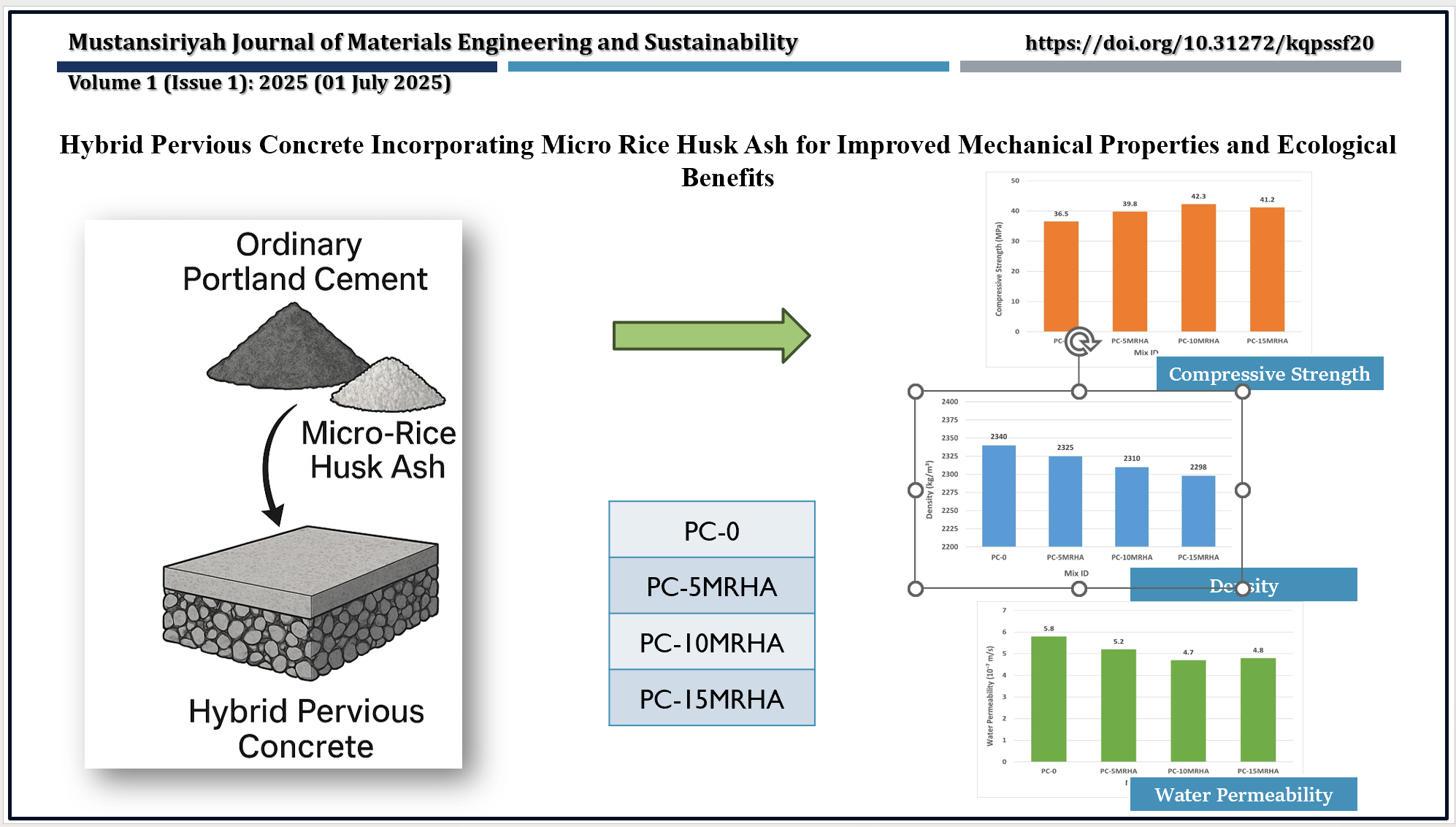
To improve mechanical qualities and sustainability, this study explores the creation of hybrid pervious concrete that partially substitutes micro-rice husk ash (MRHA) for ordinary Portland cement (OPC). MRHA replacement levels of 0, 5, 10, and 15% by weight of cement were used to create four different concrete mixtures. At 10% MRHA, the compressive strength improved by 16%, from 36.5 MPa (control) to a maximum of 42.3 MPa. At 10% MRHA, water permeability dropped from 5.8 × 10⁻⁷ m/s (control) to 4.7 × 10⁻⁷ m/s, suggesting better matrix densification. At 15% MRHA, the water absorption decreased by 15.4% from 7.8% to 6.6%. As MRHA has a lower specific gravity, the hardened density at 15% MRHA decreased slightly from 2340 kg/m³ (control) to 2298 kg/m³. The results showed that 10% MRHA replacement offers the best results in terms of strength, permeability, durability, and environmental benefits. Thus, MRHA is a viable sustainable material for environment-friendly concrete applications.
Downloads
Downloads
Published
Issue
Section
Categories
License
Copyright (c) 2025 Yasir K. Ibrahim, Ahmed S. Abba, Narmeen Abdalwahhab Abdalqadir, Akram Q. Moften, Soran Abdrahman Ahmad (Author)

This work is licensed under a Creative Commons Attribution-ShareAlike 4.0 International License.
Open Access and Copyright
MJMES follows an open-access publishing model, ensuring that all published articles are freely accessible to a global audience without any subscription or payment barriers. Every article is distributed under the Creative Commons Attribution International Public License (CC BY 4.0), which grants broad rights to individuals and institutions, allowing them to:
- Download, share, and distribute full-text articles without restrictions.
- Print, reproduce, or link to published content in any format or medium.
Although copyright ownership remains with the authors, MJMES actively promotes their work by facilitating citation tracking and visibility, thereby enhancing the impact and recognition of published research. The CC BY 4.0 license is designed to maximize the reach and reuse of scholarly publications while ensuring that appropriate credit is always attributed to the original authors.
How to Cite