A Comprehensive Extended Review of Advanced Metallic Alloys for Aerospace Structures: Processing, Properties, Recent Advances, and Future Perspectives
DOI:
https://doi.org/10.31272/mjmes.v2i2.26Keywords:
Aerospace Alloys, Aluminum Alloys, Titanium Alloys, Nickel-Based Superalloys, High-Entropy Alloys, Additive Manufacturing, Machine LearningAbstract
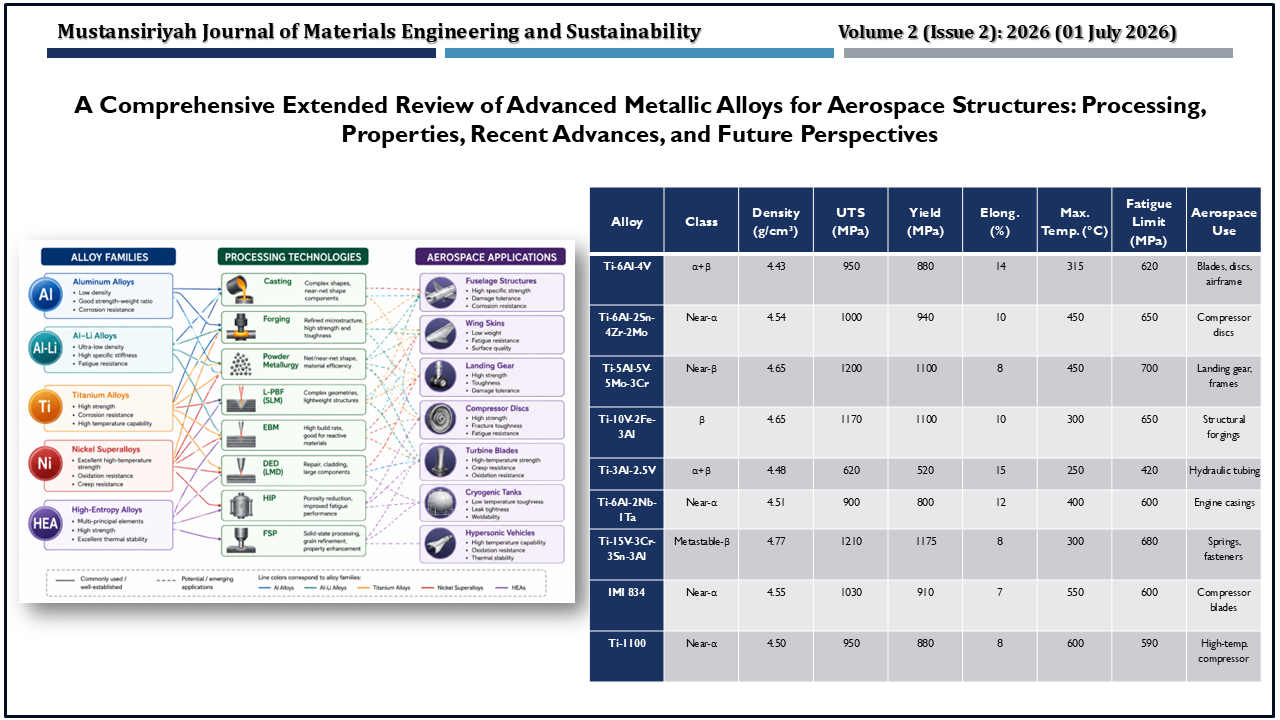
The development of advanced metallic alloys for aerospace applications is continuously progressing to meet new requirements for lightweight construction, energy efficiency, high-temperature operation, durability, and sustainability. The state-of-the-art regarding the most common metallic alloy families currently used in aerospace engineering is presented in this review. These alloys include traditional aluminum alloys, aluminum-lithium alloys, titanium alloys, nickel-based superalloys, and advanced high-entropy alloys (HEAs). The compositions, microstructures, processing methods, potential of additively manufactured parts, mechanical properties, and sustainability characteristics of these alloys were critically evaluated. Third-generation Al-Li alloys provide approximately 2-4% decrease in density and up to 10% increase in stiffness compared to conventional 2xxx and 7xxx aluminum alloys, which makes their use very effective in reducing the weight of structural elements. Titanium alloys still cannot be replaced in aerospace structural applications at medium temperatures, whereas nickel-based superalloys are widely used in turbines operating at temperatures higher than 1100-1200°C. High-entropy alloys demonstrate an outstanding combination of strength, ductility, resistance to corrosion, and high-temperature stability, with several lightweight alloys demonstrating compressive yield strengths higher than 1300 MPa at temperatures close to 1000°C. Additive manufacturing techniques have considerably promoted the adoption of topology-optimized aerospace parts; however, fatigue behavior, qualification, and certification remain problematic issues. Moreover, sustainability concerns, including embodied carbon, recyclability, and lifetime impacts, play a more important role in selecting the optimal alloy. Finally, the gaps in the research regarding long-term fatigue behavior, qualification approaches, manufacturing scalability, and machine learning-based alloy design are discussed and prioritized.
Downloads
References
[1] L. Li et al., "Low-cycle fatigue of Ni-based single crystal superalloy with film cooling holes," Fatigue Fract. Eng. Mater. Struct., vol. 47, no. 2, pp. 532–548, 2024. https://doi.org/10.1111/ffe.14178 DOI: https://doi.org/10.1111/ffe.14178
[2] Y. Li et al., "Lifetime Prediction of Single Crystal Nickel-Based Superalloys," Appl. Sci., vol. 15, no. 1, Art. no. 201, 2025. https://doi.org/10.3390/app15010201 DOI: https://doi.org/10.3390/app15010201
[3] G. Li, Z. Wu, Y. Dong, et al., "Lightweight refractory high-entropy alloys: A review," J. Mater. Res. Technol., vol. 35, pp. 3183–3204, 2025. https://doi.org/10.1016/j.jmrt.2025.02.003 DOI: https://doi.org/10.1016/j.jmrt.2025.02.003
[4] O. N. Senkov, D. B. Miracle, K. J. Chaput, and J. P. Couzinie, "Development and exploration of refractory high entropy alloys," J. Mater. Res., vol. 33, no. 19, pp. 3092–3128, 2018. https://doi.org/10.1557/jmr.2018.153 DOI: https://doi.org/10.1557/jmr.2018.153
[5] O. N. Senkov, G. B. Wilks, J. M. Scott, and D. B. Miracle, "Mechanical properties of Nb25Mo25Ta25W25 alloy at room and elevated temperature," Intermetallics, vol. 19, no. 5, pp. 698–706, 2011. https://doi.org/10.1016/j.intermet.2011.01.004 DOI: https://doi.org/10.1016/j.intermet.2011.01.004
[6] B. Gludovatz, A. Hohenwarter, D. Catoor, E. H. Chang, E. P. George, and R. O. Ritchie, "A fracture-resistant high-entropy alloy for cryogenic applications," Science, vol. 345, no. 6201, pp. 1153–1158, 2014. https://doi.org/10.1126/science.1254581 DOI: https://doi.org/10.1126/science.1254581
[7] D. B. Miracle and O. N. Senkov, "A critical review of high entropy alloys and related concepts," Acta Mater., vol. 122, pp. 448–511, 2017. https://doi.org/10.1016/j.actamat.2016.08.081 DOI: https://doi.org/10.1016/j.actamat.2016.08.081
[8] M. Tokarewicz and M. Gradzka-Dahlke, "Review of Recent Research on AlCoCrFeNi High-Entropy Alloy," Metals, vol. 11, no. 8, Art. no. 1302, 2021. https://doi.org/10.3390/met11081302 DOI: https://doi.org/10.3390/met11081302
[9] B. Cantor, I. T. H. Chang, P. Knight, and A. J. B. Vincent, "Microstructural development in equiatomic multicomponent alloys," Mater. Sci. Eng. A, vols. 375–377, pp. 213–218, 2004. https://doi.org/10.1016/j.msea.2003.10.257 DOI: https://doi.org/10.1016/j.msea.2003.10.257
[10] Q. Fan, "High-Temperature Alloys in Aerospace Applications and Future Innovations," Mater. Today Adv., vol. 27, Art. no. 100590, 2025. https://doi.org/10.1016/j.mtadv.2025.100590 DOI: https://doi.org/10.1016/j.mtadv.2025.100590
[11] T. M. Sonar, M. A. Ivanov, et al., “High entropy alloys and future perspectives in aerospace,” Journal of Physics: Conference Series, vol. 2543, Art. no. 012011, 2024
[12] H. R. Kotadia, G. J. Gibbons, A. Das, and P. D. Howes, “A review of laser powder bed fusion additive manufacturing of aluminium alloys,” Additive Manufacturing, vol. 46, Art. no. 102155, 2021. https://doi.org/10.1016/j.addma.2021.102155 DOI: https://doi.org/10.1016/j.addma.2021.102155
[13] T. M. Pollock, “Alloy design for aircraft engines,” Nature Materials, vol. 15, no. 8, pp. 809–815, 2016. https://doi.org/10.1038/nmat4709 DOI: https://doi.org/10.1038/nmat4709
[14] B. Blakey-Milner et al., “Metal additive manufacturing in aerospace: A review,” Materials & Design, vol. 209, Art. no. 110008, 2021. https://doi.org/10.1016/j.matdes.2021.110008 DOI: https://doi.org/10.1016/j.matdes.2021.110008
[15] R. Feng et al., “High-throughput design of high-performance lightweight HEAs,” Nature Communications, vol. 12, Art. no. 4329, 2021. https://doi.org/10.1038/s41467-021-24523-9 DOI: https://doi.org/10.1038/s41467-021-24523-9
[16] J. W. Yeh, S. K. Chen, S. J. Lin, et al., “Nanostructured high-entropy alloys with multiple principal elements,” Advanced Engineering Materials, vol. 6, no. 5, pp. 299–303, 2004. https://doi.org/10.1002/adem.200300567 DOI: https://doi.org/10.1002/adem.200300567
[17] T. Dursun and C. Soutis, “Recent developments in advanced aircraft aluminium alloys,” Materials & Design, vol. 56, pp. 862–871, 2014. https://doi.org/10.1016/j.matdes.2013.12.002 DOI: https://doi.org/10.1016/j.matdes.2013.12.002
[18] D. Laskowska, B. Balasz, and L. Zurawski, “Metallographic structure of L-PBF Ti-6Al-4V and Ti-6Al-7Nb,” Materials, vol. 19, no. 1, Art. no. 80, 2025. https://doi.org/10.3390/ma19010080 DOI: https://doi.org/10.3390/ma19010080
[19] Z. Yao and Z. Xie, “L-PBF of 2024 aluminum alloys modified using Nano-LaB6,” Materials, vol. 17, no. 13, Art. no. 3367, 2024. https://doi.org/10.3390/ma17133367 DOI: https://doi.org/10.3390/ma17133367
[20] P. I. Odetola et al., “High entropy alloys: Thermodynamic design and computational modeling,” Heliyon, vol. 10, no. 22, Art. no. e39660, 2024. https://doi.org/10.1016/j.heliyon.2024.e39660 DOI: https://doi.org/10.1016/j.heliyon.2024.e39660
[21] S. M. Yusuf, S. J. Cutler, and N. Gao, “Impact of metal additive manufacturing on aerospace,” Metals, vol. 9, no. 12, Art. no. 1286, 2019. https://doi.org/10.3390/met9121286 DOI: https://doi.org/10.3390/met9121286
[22] B. Parveez et al., “Scientific advancements in composite materials for aircraft,” Polymers, vol. 14, no. 22, Art. no. 5007, 2022. https://doi.org/10.3390/polym14225007 DOI: https://doi.org/10.3390/polym14225007
[23] A. Rahman, M. S. Hossain, and A. Siddique, “Machine learning approaches for diverse alloy systems,” Journal of Materials Science, vol. 60, pp. 12189–12221, 2025. https://doi.org/10.1007/s10853-025-11154-4 DOI: https://doi.org/10.1007/s10853-025-11154-4
[24] R. E. Schafrik and R. Sprague, “Saga of gas turbine materials,” Advanced Materials & Processes, vol. 162, no. 3, pp. 33–36, 2004.
[25] M. Arshad et al., “High-entropy coatings for high-temperature applications,” Coatings, vol. 12, no. 5, Art. no. 691, 2022. https://doi.org/10.3390/coatings12050691 DOI: https://doi.org/10.3390/coatings12050691
[26] N. Ma, S. Liu, et al., “Research progress of titanium-based high entropy alloy,” Frontiers in Bioengineering and Biotechnology, vol. 8, Art. no. 603522, 2020. https://doi.org/10.3389/fbioe.2020.603522 DOI: https://doi.org/10.3389/fbioe.2020.603522
[27] S. Chen, X. Fan, W. Li, and P. K. Liaw, “Fatigue behavior of high-entropy alloys,” arXiv, Art. no. 2401.07418, 2024. https://doi.org/10.48550/arXiv.2401.07418
[28] C. Beal, M. A. Moshier, H. Asgari, and P. Phanichphant, “Additively manufactured Ti-6Al-4V microstructure tailoring for fatigue,” Fatigue & Fracture of Engineering Materials & Structures, vol. 47, pp. 1684–1699, 2024. https://doi.org/10.1111/ffe.14316 DOI: https://doi.org/10.1111/ffe.14316
[29] H. Long, S. Mao, Y. Liu, et al., “Microstructural and compositional design of Ni-based single crystalline superalloys,” Journal of Alloys and Compounds, vol. 743, pp. 203–220, 2018. https://doi.org/10.1016/j.jallcom.2018.01.224 DOI: https://doi.org/10.1016/j.jallcom.2018.01.224
[30] R. Branco, F. Berto, A. Kotousov, et al., Mechanical Behaviour of Aluminium Alloys. Basel, Switzerland: MDPI Books, 2018. https://doi.org/10.3390/books978-3-03897-321-8 DOI: https://doi.org/10.3390/app8101854
[31] B. Zhou, B. Liu, and S. Zhang, “The advancement of 7XXX series aluminum alloys for aircraft structures: A review,” Metals, vol. 11, no. 5, Art. no. 718, 2021. https://doi.org/10.3390/met11050718 DOI: https://doi.org/10.3390/met11050718
[32] A. Behera, A. K. Sahoo, and S. S. Mahapatra, “Ni-based superalloy in aero turbine blade: A review,” Proceedings of the Institution of Mechanical Engineers, Part E: Journal of Process Mechanical Engineering, vol. 238, no. 3, pp. 1041–1059, 2024. https://doi.org/10.1177/09544089231219104 DOI: https://doi.org/10.1177/09544089231219104
[33] K. Gancarczyk et al., “Crystal structure of CMSX-4 single-crystal turbine blades,” Materials, vol. 18, no. 5, Art. no. 919, 2025. https://doi.org/10.3390/ma18050919 DOI: https://doi.org/10.3390/ma18050919
[34] R. C. Reed, *The Superalloys: Fundamentals and Applications*. Cambridge, U.K.: Cambridge University Press, 2006.
[35] R. Schafrik, D. D. Ward, and J. Groh, “Application of Alloy 718 in GE aircraft engines,” in *Superalloys 718, 625, 706 and Various Derivatives*, TMS, 2001, pp. 1–11. DOI: https://doi.org/10.7449/2001/Superalloys_2001_1_11
[36] J. Yu and R. Mu, “Research status of high entropy thermal barrier coatings,” Frontiers in Materials, vol. 8, Art. no. 816069, 2021. https://doi.org/10.3389/fmats.2021.816069
[37] N. K. Adomako, N. Haghdadi, and S. Primig, “AM of Ni-based superalloys: A review of microstructure heterogeneities,” Applied Materials Today, vol. 27, Art. no. 101400, 2022. https://doi.org/10.1016/j.apmt.2022.101400 DOI: https://doi.org/10.1016/j.apmt.2022.101400
[38] M.-H. Tsai and J.-W. Yeh, “High-entropy alloys: A critical review,” Materials Research Letters, vol. 2, no. 3, pp. 107–123, 2014. https://doi.org/10.1080/21663831.2014.912690 DOI: https://doi.org/10.1080/21663831.2014.912690
[39] S. Arun, N. Radhika, and B. Saleh, “Potential of high entropy alloys: Microstructure, properties and applications, Part II,” Journal of Alloys and Compounds, vol. 991, Art. no. 174472, 2024. https://doi.org/10.1016/j.jallcom.2024.174472 DOI: https://doi.org/10.1016/j.jallcom.2024.174472
[40] B. Gelchinski, I. A. Balyakin, et al., “High-entropy alloys as protective coatings,” Journal of Physics: Conference Series, vol. 2241, Art. no. 012009, 2022.
[41] P. R. Gradl, D. C. Tinker, A. Park, et al., “Robust metal AM process selection for aerospace,” Journal of Materials Engineering and Performance, vol. 31, pp. 6013–6044, 2022. https://doi.org/10.1007/s11665-022-06850-0 DOI: https://doi.org/10.1007/s11665-022-06850-0
[42] A. Hewidy, “Recent advances in friction stir processing for microstructural refinement,” Mechanical Engineering Advances, vol. 3, Art. no. 100012, 2025. DOI: https://doi.org/10.59400/mea2509
[43] Y. Liu, Y. Li, M. Wang, and Z. Chen, “Review of laser powder bed fusion microstructure for Al-Ce alloys,” Materials, vol. 17, no. 20, Art. no. 5085, 2024. https://doi.org/10.3390/ma17205085 DOI: https://doi.org/10.3390/ma17205085
[44] M. Liu, C. Lei, Y. Wang, B. Zhang, and X. Qu, “High-throughput preparation for alloy composition design in AM,” Materials Today Communications, vol. 38, Art. no. 107785, 2024. https://doi.org/10.1016/j.mtcomm.2023.107785 DOI: https://doi.org/10.1016/j.mtcomm.2023.107785
[45] T. M. Pollock and S. Tin, “Nickel-based superalloys for advanced turbine engines,” Journal of Propulsion and Power, vol. 22, no. 2, pp. 361–374, 2006. https://doi.org/10.2514/1.18239 DOI: https://doi.org/10.2514/1.18239
[46] A. Gloria, R. Montanari, M. Richetta, and A. Varone, “Alloys for aeronautic applications: State of the art and perspectives,” Metals, vol. 9, no. 6, Art. no. 662, 2019. https://doi.org/10.3390/met9060662 DOI: https://doi.org/10.3390/met9060662
[47] Y. Wang et al., “Light weight high entropy alloys: Structure, properties, and applications,” cMat, Art. no. e70014, 2025. https://doi.org/10.1002/cmt2.70014 DOI: https://doi.org/10.1002/cmt2.70014
[48] M. Richetta and A. Varone, “Additive manufacturing of aluminum alloys for aeronautic applications,” Metals, vol. 13, no. 4, Art. no. 716, 2023. https://doi.org/10.3390/met13040716 DOI: https://doi.org/10.3390/met13040716
[49] Y. Xiao et al., “Research progress of new generation aluminum-lithium alloys,” Advanced Engineering Materials, vol. 26, Art. no. 2301639, 2024. https://doi.org/10.1002/adem.202301639 DOI: https://doi.org/10.1002/adem.202301639
[50] T. Trzepiecinski and S. M. Najm, “Current trends in metallic materials for structural members,” Materials, vol. 17, no. 3, Art. no. 590, 2024. https://doi.org/10.3390/ma17030590 DOI: https://doi.org/10.3390/ma17030590
[51] M. Brewer et al., “Recent advances in joining technologies of aluminum alloys,” Discover Materials, vol. 4, Art. no. 58, 2024. https://doi.org/10.1007/s43939-024-00155-w DOI: https://doi.org/10.1007/s43939-024-00155-w
[52] R. Sliwa, B. Pawlowska, T. Balawender, and M. Zwolak, “Extrusion of lightweight aluminum and magnesium alloys for aviation,” Key Engineering Materials, vol. 926, pp. 523–536, 2022. DOI: https://doi.org/10.4028/p-mmgjqk
[53] J. C. Williams and E. A. Starke Jr., “Progress in structural materials for aerospace systems,” Acta Materialia, vol. 51, no. 19, pp. 5775–5799, 2003. https://doi.org/10.1016/j.actamat.2003.08.023 DOI: https://doi.org/10.1016/j.actamat.2003.08.023
[54] M. H. Mosallanejad et al., “Additive manufacturing of titanium alloys: Processability, properties, and applications,” Advanced Engineering Materials, vol. 25, Art. no. 2301122, 2023. https://doi.org/10.1002/adem.202301122 DOI: https://doi.org/10.1002/adem.202301122
[55] T. Pasang et al., “Additive manufacturing of titanium alloys—Enabling re-manufacturing,” Microelectronics Engineering, vol. 270, Art. no. 111935, 2023. https://doi.org/10.1016/j.mee.2022.111935 DOI: https://doi.org/10.1016/j.mee.2022.111935
[56] P. Pushp et al., “Additive manufacturing of titanium alloys for aerospace,” Review of Materials Research, vol. 1, no. 1, Art. no. 100003, 2022. https://doi.org/10.1016/j.revmat.2021.100003
[57] G. Mi, Y. Tan, H. Chen, P. Li, and X. Zhang, “Additive manufacturing of 600°C high-temperature titanium alloys,” Journal of Aeronautical Materials, vol. 44, no. 1, pp. 15–30, 2024. https://doi.org/10.11868/j.issn.1005-5053.2023.000106
[58] Y. He et al., “Enhanced low cycle fatigue of selective laser melting Ti-6Al-4V,” Journal of Materials Science & Technology, vol. 180, pp. 129–140, 2024. https://doi.org/10.1016/j.jmst.2023.09.017 DOI: https://doi.org/10.1016/j.jmst.2023.09.017
[59] R. R. Boyer, “An overview on the use of titanium in the aerospace industry,” Materials Science and Engineering A, vol. 213, nos. 1–2, pp. 103–114, 1996. https://doi.org/10.1016/0921-5093(96)10233-1 DOI: https://doi.org/10.1016/0921-5093(96)10233-1
[60] C. Leyens and M. Peters, Eds., *Titanium and Titanium Alloys: Fundamentals and Applications*. Weinheim, Germany: Wiley-VCH, 2003. DOI: https://doi.org/10.1002/3527602119
[61] G. Lütjering and J. C. Williams, *Titanium*, 2nd ed. Berlin, Germany: Springer, 2007. https://doi.org/10.1007/978-3-540-73036-1 DOI: https://doi.org/10.1007/978-3-540-73036-1
[62] L. Han, P. Li, S. Yu, et al., “Creep/fatigue failure of Ni-based superalloy turbine blade,” International Journal of Fatigue, vol. 154, Art. no. 106558, 2022. https://doi.org/10.1016/j.ijfatigue.2021.106558 DOI: https://doi.org/10.1016/j.ijfatigue.2021.106558
[63] P. Caron and T. Khan, “Evolution of Ni-based superalloys for single crystal applications,” Aerospace Science and Technology, vol. 3, no. 8, pp. 513–523, 1999. https://doi.org/10.1016/S1270-9638(99)00108-X DOI: https://doi.org/10.1016/S1270-9638(99)00108-X
[64] E. P. George, D. Raabe, and R. O. Ritchie, “High-entropy alloys,” Nature Reviews Materials, vol. 4, no. 8, pp. 515–534, 2019. https://doi.org/10.1038/s41578-019-0121-4 DOI: https://doi.org/10.1038/s41578-019-0121-4
[65] F. Otto et al., “Tensile properties of CoCrFeMnNi high-entropy alloy,” Acta Materialia, vol. 61, no. 15, pp. 5743–5755, 2013. https://doi.org/10.1016/j.actamat.2013.06.018 DOI: https://doi.org/10.1016/j.actamat.2013.06.018
[66] G. Laplanche et al., “Superior mechanical properties of medium-entropy CrCoNi,” Acta Materialia, vol. 128, pp. 292–303, 2017. https://doi.org/10.1016/j.actamat.2017.02.036 DOI: https://doi.org/10.1016/j.actamat.2017.02.036
[67] M. Dada, P. Popoola, and N. Mathe, “Recent advances of high entropy alloys for aerospace: A review,” World Journal of Engineering, vol. 20, no. 1, pp. 43–74, 2023. https://doi.org/10.1108/WJE-01-2021-0040 DOI: https://doi.org/10.1108/WJE-01-2021-0040
[68] M. Han and Z. P. Lu, “Development and applications of lightweight HEAs: A review,” Advanced Engineering Materials, vol. 27, Art. no. 2501170, 2025. https://doi.org/10.1002/adem.202501170 DOI: https://doi.org/10.1002/adem.202501170
[69] J. Hu, X. Li, et al., “An overview on fatigue of high-entropy alloys,” Materials, vol. 16, no. 24, Art. no. 7552, 2023. https://doi.org/10.3390/ma16247552 DOI: https://doi.org/10.3390/ma16247552
[70] A. Sasi, R. J. Vikram, and K. Dash, “Corrosion and oxidation of HEAs in extreme environments,” Journal of Applied Physics, vol. 138, no. 2, Art. no. 020701, 2025. https://doi.org/10.1063/5.0273671 DOI: https://doi.org/10.1063/5.0273671
[71] Q. S. Pan et al., “Recent progress in oxidation behavior of high-entropy alloys,” APL Mater., vol. 10, no. 12, Art. no. 120701, 2022. https://doi.org/10.1063/5.0127584 DOI: https://doi.org/10.1063/5.0116605
[72] H. Wu, J. Yu, Z. Jia, et al., “Progress of refractory high entropy alloys,” J. Aeronaut. Mater., vol. 44, no. 2, pp. 45–59, 2024. https://doi.org/10.11868/j.issn.1005-5053.2023.000178
[73] H. Song et al., “Refractory high entropy alloys: From fundamental research to engineering,” J. Mater. Res. Technol., vol. 32, pp. 3562–3585, 2024. https://doi.org/10.1016/j.jmrt.2024.08.180 DOI: https://doi.org/10.1016/j.jmrt.2024.08.180
[74] S. Lee, S. S. Sohn, et al., “Accelerating HEA design via machine learning: Yield strength prediction,” Materials, vol. 19, no. 1, Art. no. 196, 2026. https://doi.org/10.3390/ma19010196 DOI: https://doi.org/10.3390/ma19010196
[75] “Latest advancements in high-entropy alloys: Design, properties and applications,” Materials, vol. 18, no. 24, Art. no. 5616, 2025. https://doi.org/10.3390/ma18245616 DOI: https://doi.org/10.3390/ma18245616
[76] M. C. Gao, J.-W. Yeh, P. K. Liaw, and Y. Zhang, Eds., High-Entropy Alloys: Fundamentals and Applications. Cham, Switzerland: Springer, 2016. https://doi.org/10.1007/978-3-319-27013-5 DOI: https://doi.org/10.1007/978-3-319-27013-5
[77] M. Vaidya, G. M. Muralikrishna, and B. S. Murty, “High-entropy alloys by mechanical alloying,” J. Mater. Res., vol. 34, no. 5, pp. 664–686, 2019. https://doi.org/10.1557/jmr.2019.37 DOI: https://doi.org/10.1557/jmr.2019.37
[78] M. Dada, High Entropy Alloys for Aerospace Applications. London, U.K.: IntechOpen, 2019. https://doi.org/10.5772/intechopen.85821 DOI: https://doi.org/10.5772/intechopen.85821
[79] S. Zhu et al., “Accelerating CALPHAD-based phase diagram predictions using ML potentials,” arXiv preprint arXiv:2411.15351, 2024.
[80] S. Bordignon et al., “Alloys innovation through machine learning: A statistical review,” Sci. Technol. Adv. Mater. Methods, vol. 4, Art. no. 2326305, 2024. https://doi.org/10.1080/27660400.2024.2326305 DOI: https://doi.org/10.1080/27660400.2024.2326305
[81] Z. Guo, Z. Chen, Y. Zeng, et al., “Refractory high-entropy alloys by selective laser melting,” Acta Aeronaut. Astronaut. Sin., vol. 44, 2023. https://doi.org/10.7527/S1000-6893.2023.29518
[82] P. F. Rodrigues et al., “Design of additive manufactured shape memory alloy for aerospace,” in Proc. Euro PM2025, 2025.
[83] ASM International, ASM Handbook, Volume 2: Properties and Selection of Nonferrous Alloys. Materials Park, OH, USA: ASM International, 1990.
[84] ASM International, ASM Aerospace Specification Metals Database. Materials Park, OH, USA: ASM International, 2024.
[85] R. J. H. Wanhill, S. Barter, and L. Molent, Fatigue of Beta Processed Titanium Alloys. Cham, Switzerland: Springer, 2019. https://doi.org/10.1007/978-94-024-1285-0
[86] A. P. Mouritz, Introduction to Aerospace Materials. Cambridge, U.K.: Woodhead Publishing, 2012. DOI: https://doi.org/10.2514/4.869198
[87] M. J. Donachie and S. J. Donachie, Superalloys: A Technical Guide, 2nd ed. Materials Park, OH, USA: ASM International, 2002. DOI: https://doi.org/10.31399/asm.tb.stg2.9781627082679
[88] R. R. Boyer, G. Welsch, and E. W. Collings, Eds., Materials Properties Handbook: Titanium Alloys. Materials Park, OH, USA: ASM International, 1994.
Downloads
Published
Issue
Section
Categories
License
Copyright (c) 2026 Waleed Kadhim Al-Azzawi, Ola Abdullah Abed (Author)

This work is licensed under a Creative Commons Attribution 4.0 International License.
Open Access and Copyright
MJMES follows an open-access publishing model, ensuring that all published articles are freely accessible to a global audience without any subscription or payment barriers. Every article is distributed under the Creative Commons Attribution International Public License (CC BY 4.0), which grants broad rights to individuals and institutions, allowing them to:
- Download, share, and distribute full-text articles without restrictions.
- Print, reproduce, or link to published content in any format or medium.
Although copyright ownership remains with the authors, MJMES actively promotes their work by facilitating citation tracking and visibility, thereby enhancing the impact and recognition of published research. The CC BY 4.0 license is designed to maximize the reach and reuse of scholarly publications while ensuring that appropriate credit is always attributed to the original authors.
How to Cite