Recent Advances in the Use of Cellulosic Polymers for Enhancing Concrete Performance: A Comprehensive Review
DOI:
https://doi.org/10.31272/mjmes.v2i2.28Keywords:
cellulosic polymers, nanocellulose, mechanical strength, sustainable constructionAbstract
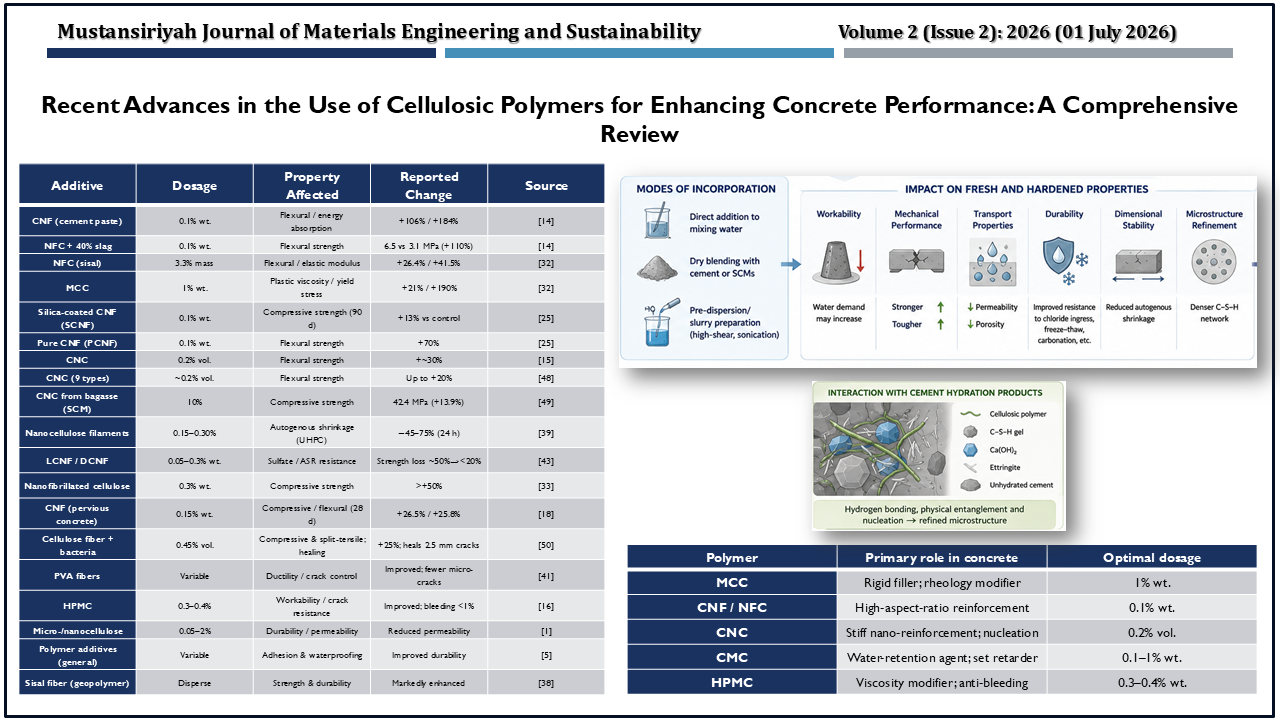
Cellulose, the most prevalent biopolymer on Earth, has proven to be an effective multifunctional material for enhancing the performance of concrete and other cement-based products. The current review analyzes recent developments in the application of cellulosic polymers in concrete and cement composites, including microcrystalline cellulose (MCC), cellulose nanofibrils (CNF/NFC), cellulose nanocrystals (CNC), carboxymethyl cellulose (CMC), and hydroxypropyl methylcellulose (HPMC). Special attention is paid to their interfacial interactions with cement hydration products, modes of incorporation, and impact on the properties of fresh concrete and performance of hardened materials (mechanical performance, transport properties, durability, etc.). According to published data, the addition of CNF in an amount of approximately 0.1 wt. % results in a 106% enhancement of flexural strength and a 184% increase in energy absorption capacity. Meanwhile, the flexural strength was enhanced by CNC (approximately 0.2 vol. %) by approximately 30%. Ultra-high-performance concrete containing nanocellulose experienced a 45-75% reduction in autogenous shrinkage in the initial 24 h. Nevertheless, the effects and signs of these improvements are strongly determined by the cellulose structure, dosage, surface chemistry, dispersion quality, consumption of water, cement formulation, and other parameters, which must be controlled because excessive amounts of cellulose and its improper dispersion could negatively influence the workability, hydration process, and strength development. In addition, potential drawbacks such as agglomeration, requirement for high energy input for dispersion, incompatibility with certain chemical admixtures, durability under aggressive environments, and other factors are considered in this review.
Downloads
References
[1] A. A. B. Omran, A. A. Mohammed, S. M. Sapuan, R. A. Ilyas, M. R. M. Asyraf, S. S. Rahimian Koloor, and M. Petrů, "Micro- and Nanocellulose in Polymer Composite Materials: A Review," Polymers, vol. 13, no. 2, art. no. 231, 2021. https://doi.org/10.3390/polym13020231 DOI: https://doi.org/10.3390/polym13020231
[2] Q. Qin, S. Zeng, G. Duan, Y. Liu, X. Han, R. Yu, et al., "Bottom-Up and Top-Down Strategies Toward Strong Cellulose-Based Materials," Chem. Soc. Rev., vol. 53, no. 18, pp. 9306–9343, 2024. https://doi.org/10.1039/D4CS00308F DOI: https://doi.org/10.1039/D4CS00387J
[3] F. S. Merritt, Building Design and Construction Handbook. New York, NY, USA: McGraw-Hill, 2001.
[4] M. Grantham, C. Majorana, and V. Salomoni, "A Low Frequency Electromagnetic Probe for Detection of Corrosion in Steel-Reinforced Concrete," in Concrete Solutions, M. Grantham, Ed. Boca Raton, FL, USA: CRC Press, 2009, pp. 431–438. DOI: https://doi.org/10.1201/9780203864005-81
[5] N. Y. Bekturganova and I. V. Kolesnikova, "Effect of Polymer Additives on Improvement of Concrete Properties," Adv. Polym. Technol., vol. 2025, art. no. 6235216, 2025. https://doi.org/10.1155/2025/6235216 DOI: https://doi.org/10.1155/adv/6235216
[6] Z. Q. S. Nwokediegwu, V. I. Ilojianya, K. I. Ibekwe, A. Adefemi, E. A. Etukudoh, and A. A. Umoh, "Advanced Materials for Sustainable Construction: A Review of Innovations and Environmental Benefits," Eng. Sci. Technol. J., 2024.
[7] A. Dhar, "Material Innovations for Climate Resilience: A Mini Review," Sci. Dialectica, vol. 2, no. 2, pp. 57–64, 2025. https://doi.org/10.5281/zenodo.14753949 DOI: https://doi.org/10.54162/SD02-260208/04
[8] M. O. B. C. Melo, L. B. da Silva, A. S. Coutinho, V. Sousa, and N. Perazzo, "Energy Efficiency in Building Installations Using Thermal Insulating Materials in Northeast Brazil," Energy Build., vol. 47, pp. 35–43, 2012. https://doi.org/10.1016/j.enbuild.2011.11.053 DOI: https://doi.org/10.1016/j.enbuild.2011.11.053
[9] H. Bjorntvedt, "New Materials in Structural Design," Master's thesis, Universitat Politècnica de València, Valencia, Spain, 2013.
[10] A. Hashem, S. Farag, and S. M. Badawy, "Carboxymethyl Cellulose: Past Innovations, Present Applications, and Future Horizons," Results Chem., art. no. 102534, 2025. https://doi.org/10.1016/j.rechem.2025.102534 DOI: https://doi.org/10.1016/j.rechem.2025.102534
[11] M. S. Rahman, M. S. Hasan, A. S. Nitai, S. Nam, A. K. Karmakar, M. S. Ahsan, and M. J. A. Shiddiky, "Recent Developments of Carboxymethyl Cellulose," Polymers, vol. 13, no. 8, art. no. 1345, 2021. https://doi.org/10.3390/polym13081345 DOI: https://doi.org/10.3390/polym13081345
[12] T. Aziz, A. Farid, F. Haq, M. Kiran, A. Ullah, K. Zhang, and L. Cheng, "A Review on the Modification of Cellulose and Its Applications," Polymers, vol. 14, no. 15, art. no. 3206, 2022. https://doi.org/10.3390/polym14153206 DOI: https://doi.org/10.3390/polym14153206
[13] D. Trache, M. H. Hussin, M. K. M. Haafiz, and V. K. Thakur, "Recent Progress in Cellulose Nanocrystals: Sources and Production," Nanoscale, vol. 9, no. 5, pp. 1763–1786, 2017. https://doi.org/10.1039/C6NR09494E DOI: https://doi.org/10.1039/C6NR09494E
[14] O. Onuaguluchi, D. K. Panesar, and M. Sain, "Properties of Nanofibre Reinforced Cement Composites," Constr. Build. Mater., vol. 63, pp. 119–124, 2014. https://doi.org/10.1016/j.conbuildmat.2014.04.025 DOI: https://doi.org/10.1016/j.conbuildmat.2014.04.072
[15] Y. Cao, P. Zavattieri, J. Youngblood, R. Moon, and J. Weiss, "The Influence of Cellulose Nanocrystal Additions on the Performance of Cement Paste," Cem. Concr. Compos., vol. 56, pp. 73–83, 2015. https://doi.org/10.1016/j.cemconcomp.2014.11.008 DOI: https://doi.org/10.1016/j.cemconcomp.2014.11.008
[16] X. Gu, X. Li, W. Zhang, Y. Gao, Y. Kong, J. Liu, and X. Zhang, "Effects of HPMC on Workability and Mechanical Properties of Concrete Using Iron Tailings as Aggregates," Materials, vol. 14, no. 21, art. no. 6451, 2021. https://doi.org/10.3390/ma14216451 . DOI: https://doi.org/10.3390/ma14216451
[17] R. J. Moon, A. Martini, J. Nairn, J. Simonsen, and J. Youngblood, "Cellulose Nanomaterials Review: Structure, Properties and Nanocomposites," Chem. Soc. Rev., vol. 40, no. 7, pp. 3941–3994, 2011. https://doi.org/10.1039/C0CS00108B DOI: https://doi.org/10.1039/c0cs00108b
[18] X. Zhang, C. Lei, Z. Li, A. Zhang, W. Zhao, W. Zhang, J. Xu, and P. Guo, "Effect of Cellulose Nanofibrils on the Physical Properties and Frost Resistance of Pervious Concrete," Materials, vol. 15, no. 22, art. no. 7906, 2022. https://doi.org/10.3390/ma15227906 DOI: https://doi.org/10.3390/ma15227906
[19] E. Kontturi, P. Laaksonen, M. B. Linder, Nonappa, A. H. Gröschel, O. J. Rojas, and O. Ikkala, "Advanced Materials Through Assembly of Nanocelluloses," Adv. Mater., vol. 30, no. 24, art. no. 1703779, 2018. https://doi.org/10.1002/adma.201703779 DOI: https://doi.org/10.1002/adma.201703779
[20] X. Yang, S. K. Biswas, J. Han, S. Tanpichai, M.-C. Li, C. Chen, S. Zhu, A. K. Das, and H. Yano, "Surface and Interface Engineering for Nanocellulosic Advanced Materials," Adv. Mater., vol. 33, no. 28, art. no. 2002264, 2021. https://doi.org/10.1002/adma.202002264 DOI: https://doi.org/10.1002/adma.202002264
[21] Y. Zhao, S. Wang, Z. Wei, S. Qiu, G. Zhou, J. H. He, and X. Xu, "Natural toolbox—Chemical engineering aspect and high-value applications of Janus cellulose nanomaterials," Adv. Sci., vol. 12, no. 28, Art. no. e00820, 2025. https://doi.org/10.1002/advs.202500820 DOI: https://doi.org/10.1002/advs.202500820
[22] U. Kilic, N. Soliman, A. A. B. Omran, and O. E. Ozbulut, "Effects of cellulose nanofibrils on rheological and mechanical properties of 3D printable cement composites," Cem. Concr. Compos., vol. 152, Art. no. 105617, 2024. https://doi.org/10.1016/j.cemconcomp.2024.105617 DOI: https://doi.org/10.1016/j.cemconcomp.2024.105617
[23] A. Al Fahim, N. Admassu, G. Dailey, and M. Khanzadeh Moradllo, "Application of cellulose nanocrystals in 3D printed alkali-activated cementitious composites," J. Build. Eng., vol. 82, Art. no. 108380, 2024. https://doi.org/10.1016/j.jobe.2023.108380 DOI: https://doi.org/10.1016/j.jobe.2023.108380
[24] K. Wu, H. Han, L. Xu, Y. Gao, Z. Yang, Z. Jiang, and G. De Schutter, "The improvement of freezing–thawing resistance of concrete by cellulose/polyvinyl alcohol hydrogel," Constr. Build. Mater., vol. 291, Art. no. 123274, 2021. https://doi.org/10.1016/j.conbuildmat.2021.123274 DOI: https://doi.org/10.1016/j.conbuildmat.2021.123274
[25] K. S. Kamasamudram, W. Ashraf, and E. N. Landis, "Cellulose nanocomposites for performance enhancement of ordinary Portland cement-based materials," Transp. Res. Rec., vol. 2675, no. 9, pp. 11–20, 2021. https://doi.org/10.1177/03611981211005752 DOI: https://doi.org/10.1177/0361198120958421
[26] A. Guo, D. Gao, Z. Sun, H. Feng, Z. Yu, Z. Guo, H. Shang, and F. Liu, "Hydration kinetics and mechanism of C₃S with cellulose nanocrystals," Cem. Concr. Compos., vol. 148, Art. no. 105447, 2024. https://doi.org/10.1016/j.cemconcomp.2024.105447 DOI: https://doi.org/10.1016/j.cemconcomp.2024.105447
[27] A. S. J. Al-Askary, K. Kopecsko, and D. Oktay, "Cellulose nanocrystals and their utilization in cement-based composites: A comprehensive review," Case Stud. Constr. Mater., Art. no. e05550, 2025. https://doi.org/10.1016/j.cscm.2025.e05550 DOI: https://doi.org/10.1016/j.cscm.2025.e05550
[28] O. A. Mohamed and H. A. Zuaiter, "Fresh properties, strength, and durability of fiber-reinforced geopolymer and conventional concrete: A review," Polymers, vol. 16, no. 1, Art. no. 141, 2024. https://doi.org/10.3390/polym16010141 DOI: https://doi.org/10.3390/polym16010141
[29] C. Androuët and J.-P. Charron, "Shrinkage mitigation of an ultra-high performance concrete submitted to various mixing and curing conditions," Materials, vol. 14, no. 14, Art. no. 3982, 2021. https://doi.org/10.3390/ma14143982 DOI: https://doi.org/10.3390/ma14143982
[30] A. Guo, Z. Sun, N. Sathitsuksanoh, and H. Feng, "A review on the application of nanocellulose in cementitious materials," Nanomaterials, vol. 10, no. 12, Art. no. 2476, 2020. https://doi.org/10.3390/nano10122476 DOI: https://doi.org/10.3390/nano10122476
[31] S. Nassiri, Z. Chen, G. Jian, T. Zhong, M. M. Haider, H. Li, and M. Wolcott, "Comparison of unique effects of two contrasting types of cellulose nanomaterials on setting time, rheology, and compressive strength of cement paste," Cem. Concr. Compos., vol. 123, Art. no. 104201, 2021. https://doi.org/10.1016/j.cemconcomp.2021.104201 DOI: https://doi.org/10.1016/j.cemconcomp.2021.104201
[32] M. Ardanuy, J. Claramunt, and R. D. Toledo Filho, "Cellulosic fiber reinforced cement-based composites: A review of recent research," Constr. Build. Mater., vol. 79, pp. 115–128, 2015. https://doi.org/10.1016/j.conbuildmat.2015.01.035 DOI: https://doi.org/10.1016/j.conbuildmat.2015.01.035
[33] R. Mejdoub, H. Hammi, J. J. Suñol, M. Khitouni, A. M'nif, and S. Boufi, "Nanofibrillated cellulose as nanoreinforcement in Portland cement: Thermal, mechanical and microstructural properties," J. Compos. Mater., vol. 51, no. 17, pp. 2491–2503, 2017. https://doi.org/10.1177/0021998316670682 DOI: https://doi.org/10.1177/0021998316672090
[34] S. Barbhuiya, B. B. Das, K. Kapoor, R. Davis, and B. Kondraivendhan, "Review of natural vs recycled fibres in concrete: Strength, durability and eco impacts," Proc. Inst. Civ. Eng. Constr. Mater., vol. 178, no. 6, pp. 286–306, 2024. https://doi.org/10.1680/jcoma.22.00140 DOI: https://doi.org/10.1680/jcoma.25.00060
[35] M. B. Khan, N. Shafiq, A. Waqar, D. Radu, C. Cismaș, M. Imran, and H. Almujibah, "Effects of jute fiber on fresh and hardened characteristics of concrete with environmental assessment," Buildings, vol. 13, no. 7, Art. no. 1691, 2023. https://doi.org/10.3390/buildings13071691 DOI: https://doi.org/10.3390/buildings13071691
[36] A. Waqar, M. B. Khan, M. T. Afzal, D. Radu, T. Gălățanu, C. E. Cazacu, and Y. A. Dodo, "Investigating the synergistic effects of carbon fiber and silica fume on concrete strength and eco-efficiency," Case Stud. Constr. Mater., vol. 20, Art. no. e02967, 2024. https://doi.org/10.1016/j.cscm.2024.e02967 DOI: https://doi.org/10.1016/j.cscm.2024.e02967
[37] M. K. Rao, N. Sandeep, and B. K. Rao, "An experimental study on high strength geopolymer concrete," Int. J. Sci. Technol. Eng., vol. 12, no. 12, pp. 1617–1626, 2024. DOI: https://doi.org/10.22214/ijraset.2024.66089
[38] E. M. Shcherban', S. A. Stel'makh, A. N. Beskopylny, B. Meskhi, I. Efremenko, A. A. Shilov, I. Vialikov, O. Ananova, A. Chernil'nik, and D. Elshaeva, "Composition, structure and properties of geopolymer concrete dispersedly reinforced with sisal fiber," Buildings, vol. 14, no. 9, Art. no. 2810, 2024. https://doi.org/10.3390/buildings14092810 DOI: https://doi.org/10.3390/buildings14092810
[39] O. A. Hisseine, N. A. Soliman, B. Tolnai, and A. Tagnit-Hamou, "Nano-engineered ultra-high performance concrete for controlled autogenous shrinkage using nanocellulose," Cem. Concr. Res., vol. 137, Art. no. 106217, 2020. https://doi.org/10.1016/j.cemconres.2020.106217 DOI: https://doi.org/10.1016/j.cemconres.2020.106217
[40] D. Barnat-Hunek, M. Szymańska-Chargot, M. Jarosz-Hadam, and G. Łagód, "Effect of cellulose nanofibrils and nanocrystals on physical properties of concrete," Constr. Build. Mater., vol. 223, pp. 1–11, 2019. https://doi.org/10.1016/j.conbuildmat.2019.06.206 DOI: https://doi.org/10.1016/j.conbuildmat.2019.06.145
[41] A. A. El-Sayed, H. Hamdy, M. M. Khalil, and M. Said, "Structural performance of hybrid reinforced concrete beams containing polyvinyl alcohol fibers under thermal loads," J. Build. Eng., vol. 96, Art. no. 110666, 2024. https://doi.org/10.1016/j.jobe.2024.110666 DOI: https://doi.org/10.1016/j.jobe.2024.110666
[42] P. Mehrabi, U. Dackermann, R. Siddique, and M. Rashidi, "A review on the effect of synthetic fibres, including macro fibres, on the thermal behaviour of fibre-reinforced concrete," Buildings, vol. 14, no. 12, Art. no. 4006, 2024. https://doi.org/10.3390/buildings14124006 DOI: https://doi.org/10.3390/buildings14124006
[43] S. A. O. Nair, G. Sant, and N. Neithalath, "Role of delignified and lignin-containing cellulose nanofibers in enhancing durability performances of Portland cement composites," Cem. Concr. Compos., vol. 145, Art. no. 105338, 2024. https://doi.org/10.1016/j.cemconcomp.2023.105338 DOI: https://doi.org/10.1016/j.cemconcomp.2023.105338
[44] J. Gonçalves, Y. Boluk, and V. Bindiganavile, "Cellulose nanofibres (CNF) for sulphate resistance in cement-based systems," Cem. Concr. Compos., vol. 99, pp. 100–111, 2019. https://doi.org/10.1016/j.cemconcomp.2019.03.008 DOI: https://doi.org/10.1016/j.cemconcomp.2019.03.005
[45] J. Nilimaa and V. Zhaka, "An overview of smart materials and technologies for concrete construction in cold weather," Eng, vol. 4, no. 2, pp. 1550–1580, 2023. https://doi.org/10.3390/eng4020089 DOI: https://doi.org/10.3390/eng4020089
[46] T. S. Alahmari, T. A. Abdalla, and M. A. M. Rihan, "Review of recent developments regarding the durability performance of eco-friendly geopolymer concrete," Buildings, vol. 13, no. 12, Art. no. 3033, 2023. https://doi.org/10.3390/buildings13123033 DOI: https://doi.org/10.3390/buildings13123033
[47] S. Sbahieh, M. Rabie, U. Ebead, and S. G. Al-Ghamdi, "The mechanical and environmental performance of fiber-reinforced polymers in concrete structures: Opportunities, challenges and future directions," Buildings, vol. 12, no. 9, Art. no. 1417, 2022. https://doi.org/10.3390/buildings12091417 DOI: https://doi.org/10.3390/buildings12091417
[48] T. Fu, F. Montes, P. Suraneni, J. Youngblood, and J. Weiss, "The influence of cellulose nanocrystals on the hydration and flexural strength of Portland cement pastes," Polymers, vol. 9, no. 9, Art. no. 424, 2017. https://doi.org/10.3390/polym9090424 DOI: https://doi.org/10.3390/polym9090424
[49] A. Tadesse and G. Lubo, "Enhancing cement mechanical properties with cellulose nanocrystals as supplementary cementitious materials," Discover Civil Eng., vol. 2, Art. no. 171, 2025. https://doi.org/10.1007/s44290-025-00171-2 DOI: https://doi.org/10.1007/s44290-025-00171-6
[50] A. Bras, F. Gonçalves, and P. Faria, "Self-healing of macroscopic cracks in concrete by cellulose fiber-carried microbes," J. Build. Eng., vol. 89, Art. no. 109513, 2024. https://doi.org/10.1016/j.jobe.2024.109513 DOI: https://doi.org/10.1016/j.jobe.2024.109513
[51] S. Barbhuiya, B. B. Das, and F. Kanavaris, "Biochar-concrete: A comprehensive review of properties, production and sustainability," Case Stud. Constr. Mater., vol. 20, Art. no. e02859, 2024. https://doi.org/10.1016/j.cscm.2024.e02859 DOI: https://doi.org/10.1016/j.cscm.2024.e02859
[52] Y. Zhang, M. He, L. Wang, J. Yan, B. Ma, X. Zhu, et al., "Biochar as construction materials for achieving carbon neutrality," Biochar, vol. 4, no. 1, Art. no. 59, 2022. https://doi.org/10.1007/s42773-022-00183-w DOI: https://doi.org/10.1007/s42773-022-00183-w
[53] H. Y. Jaramillo, O. H. Vasco-Echeverri, L. A. Moreno-Pacheco, and R. A. García-León, "Biomaterials in concrete for engineering applications: A bibliometric review," Infrastructures, vol. 8, no. 11, Art. no. 161, 2023. https://doi.org/10.3390/infrastructures8110161 DOI: https://doi.org/10.3390/infrastructures8110161
[54] P. J. Nóvoa, M. C. Ribeiro, and A. Ferreira, "Mechanical behaviour of cork-modified polymer concrete," in Mater. Sci. Forum, vol. 455, May 2004, pp. 805–809. https://doi.org/10.4028/www.scientific.net/MSF.455-456.805 DOI: https://doi.org/10.4028/www.scientific.net/MSF.455-456.805
[55] S. Adhikari, O. Ozdemir, and P. Saha, "Economic and environmental impact analysis of cellulose nanofiber-reinforced concrete mixture production," Sustain. Mater. Technol., vol. 37, Art. no. e00691, 2023. https://doi.org/10.1016/j.susmat.2023.e00691 DOI: https://doi.org/10.1016/j.susmat.2023.e00691
[56] T. Hu, S. Hokkanen, and B. Bhandari, "Harmonized life-cycle inventories of nanocellulose and its application in composites," Environ. Sci. Technol., vol. 58, no. 1, pp. 89–100, 2024. https://doi.org/10.1021/acs.est.3c05331
[57] A. J. Zulfikar, M. Y. Yuhazri, S. Pranoto, D. A. A. Ritonga, and Z. Husin, "Toughness analysis of jute laminate composites as wrapping for cylindrical concrete columns," JTTM: J. Terapan Tek. Mesin, vol. 6, no. 1, pp. 70–76, 2025. DOI: https://doi.org/10.37373/jttm.v6i1.1467
[58] M. Valente, M. Sambucci, and A. Sibai, "Geopolymers vs. cement matrix materials: How nanofiller can help a sustainability approach for smart construction applications—A review," Nanomaterials, vol. 11, no. 8, Art. no. 2007, 2021. https://doi.org/10.3390/nano11082007 DOI: https://doi.org/10.3390/nano11082007
Downloads
Published
Issue
Section
Categories
License
Copyright (c) 2026 Ali Noori, Mustafa Kamal Al-Kamal, Shah Rizal Kasim (Author)

This work is licensed under a Creative Commons Attribution 4.0 International License.
Open Access and Copyright
MJMES follows an open-access publishing model, ensuring that all published articles are freely accessible to a global audience without any subscription or payment barriers. Every article is distributed under the Creative Commons Attribution International Public License (CC BY 4.0), which grants broad rights to individuals and institutions, allowing them to:
- Download, share, and distribute full-text articles without restrictions.
- Print, reproduce, or link to published content in any format or medium.
Although copyright ownership remains with the authors, MJMES actively promotes their work by facilitating citation tracking and visibility, thereby enhancing the impact and recognition of published research. The CC BY 4.0 license is designed to maximize the reach and reuse of scholarly publications while ensuring that appropriate credit is always attributed to the original authors.
How to Cite