Effect of Nanomaterials on the Mechanical and Durability Properties of Concrete: A Critical Review
DOI:
https://doi.org/10.31272/mjmes.v2i2.27Keywords:
Nanomaterials, Concrete Compressive Strength, Durability, Nano-Silica, Carbon Nanotubes, Microstructure, C-S-H Gel Permeability, SustainabilityAbstract
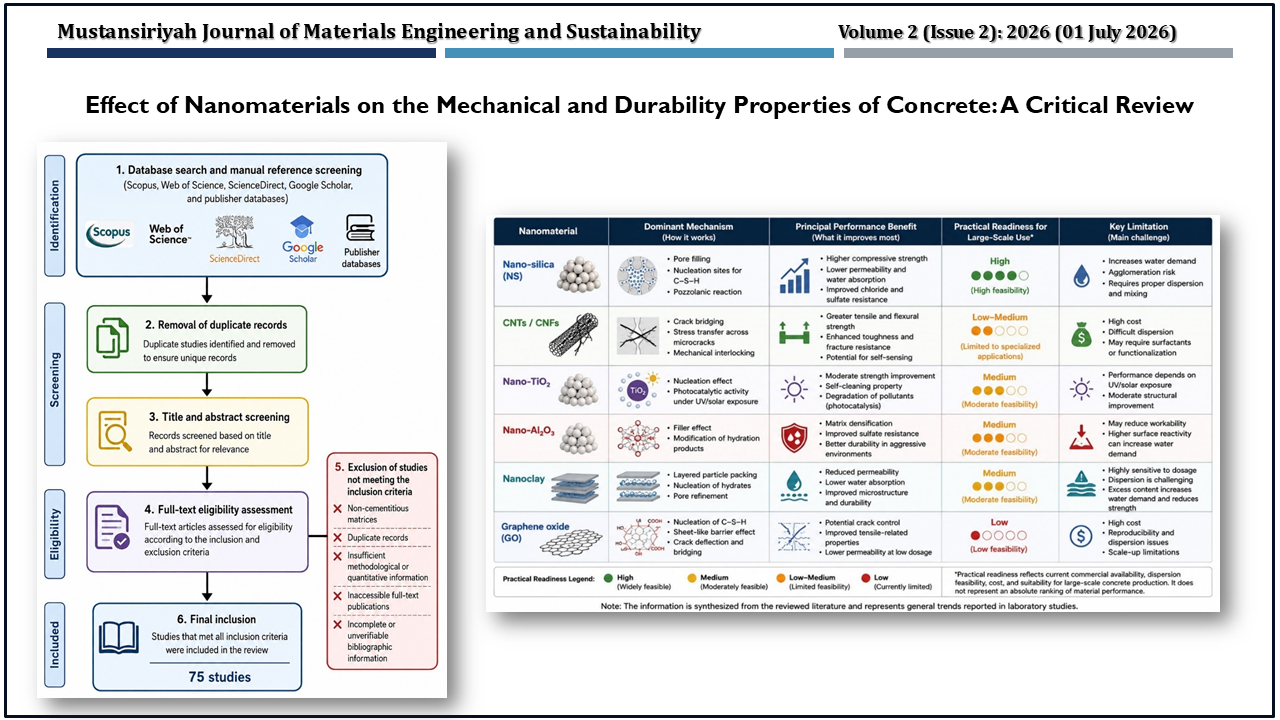
Concrete is the most widely used construction material for these purposes. However, its longevity is frequently compromised by cracking, permeability, chloride penetration, sulfate attack, and associated deterioration processes. Nanomaterials can enhance cementitious composites through pore refinement, accelerated hydration, densification of the interfacial transition zone, and crack-control behavior. The current critical review is focused on the evaluation of the impact of nano-silica (NS), carbon nanotubes and carbon nanofibers (CNTs/CNFs), nano-titanium dioxide (nano-TiO₂), nano-alumina (nano-Al₂O₃), nanoclay, and graphene oxide (GO) on the mechanical and durability performance of concrete. Generally speaking, nano-silica has the highest potential among nanomaterials for providing a consistently high strength increase of about 10-35%, reduction of water absorption, and chloride migration in the range of 20-60%. Meanwhile, carbon-based nanomaterials tend to have a higher potential for improving the tensile and flexural properties of concrete, which is usually observed at 15-50%. Nano-TiO₂ gives rather modest mechanical properties but also provides photocatalytic activity. At the same time, nano-Al₂O₃, nanoclay, and GO have the potential for densifying the matrix, reducing permeability, sulfate resistance, and crack control. It should be noted that all reported values depend on the specific features of the nanoparticles, their dosage, distribution quality, concrete composition, curing regime, and testing procedure. Widespread implementation is restricted by agglomeration, increased demand for water, high prices, lack of field validation, health hazards, and lack of testing standards. Overall, nano-silica shows the best combination of performance and feasibility, whereas carbon-based nanomaterials and GO are applicable only in specialized cases.
Downloads
References
[1] P. K. Mehta and P. J. M. Monteiro, Concrete: Microstructure, Properties, and Materials, 4th ed. New York, NY, USA: McGraw-Hill Education, 2014.
[2] A. M. Neville, Properties of Concrete, 5th ed. Harlow, U.K.: Pearson Education, 2011.
[3] M. Ismail, C. K. Yew, and B. Muhammad, "Life-Span Prediction of Abandoned Reinforced Concrete Residential Buildings," Constr. Build. Mater., vol. 112, pp. 1059–1065, 2016. https://doi.org/10.1016/j.conbuildmat.2016.03.012 DOI: https://doi.org/10.1016/j.conbuildmat.2016.03.012
[4] S. Du, J. Wu, O. AlShareedah, and X. Shi, "Nanotechnology in Cement-Based Materials: A Review of Durability, Modeling, and Advanced Characterization," Nanomaterials, vol. 9, no. 9, art. no. 1213, 2019. https://doi.org/10.3390/nano9091213 DOI: https://doi.org/10.3390/nano9091213
[5] Z. Xu, Z. Bai, J. Wu, H. Long, H. Deng, Z. Chen, et al., "Microstructural Characteristics and Nano-Modification of Interfacial Transition Zone in Concrete: A Review," Nanotechnol. Rev., vol. 11, pp. 2078–2100, 2022. https://doi.org/10.1515/ntrev-2022-0125 DOI: https://doi.org/10.1515/ntrev-2022-0125
[6] S. A. Z. Castro, R. Salgado-Estrada, L. C. Sandoval Herazo, R. A. Meléndez Armenta, E. Manzano-Huerta, E. Yelmi-Carrillo, et al., "Sustainable Development of Concrete Through Aggregates and Innovative Materials: A Review," Appl. Sci., vol. 11, no. 2, art. no. 629, 2021. https://doi.org/10.3390/app11020629 DOI: https://doi.org/10.3390/app11020629
[7] R. Rajbahadur, N. Kumar, P. K. Yadav, and M. S. Rawat, "Innovative Approaches to Sustainable Concrete Design: Exploring Green Materials for Enhanced Durability in Civil Engineering Structures," J. New Stud., vol. 14, 2025. https://doi.org/10.52783/jns.v14.2188 DOI: https://doi.org/10.52783/jns.v14.2188
[8] F. Sanchez and K. Sobolev, "Nanotechnology in Concrete—A Review," Constr. Build. Mater., vol. 24, no. 11, pp. 2060–2071, 2010. https://doi.org/10.1016/j.conbuildmat.2010.03.014 DOI: https://doi.org/10.1016/j.conbuildmat.2010.03.014
[9] K. Sobolev, "Nanotechnology and Nanoengineering of Construction Materials," in Nanotechnology in Construction 3, P. J. M. Bartos, J. J. Hughes, P. Trtik, and W. Zhu, Eds. Berlin, Germany: Springer, 2009, pp. 137–145. https://doi.org/10.1007/978-3-642-00980-8_17 DOI: https://doi.org/10.1007/978-3-642-00980-8_17
[10] Q. Yang, Q. Yang, X. Peng, K. Xia, and B. Xu, "A Review of the Effects of Nanomaterials on the Properties of Concrete," Buildings, vol. 15, no. 13, art. no. 2363, 2025. https://doi.org/10.3390/buildings15132363. DOI: https://doi.org/10.3390/buildings15132272
[11] A. H. Shekari and M. S. Razzaghi, "Influence of Nano Particles on Durability and Mechanical Properties of High Performance Concrete," Procedia Eng., vol. 14, pp. 3036–3041, 2011. https://doi.org/10.1016/j.proeng.2011.07.382 DOI: https://doi.org/10.1016/j.proeng.2011.07.382
[12] G. F. Huseien, "A Review on Concrete Composites Modified with Nanoparticles," J. Compos. Sci., vol. 7, no. 2, art. no. 67, 2023. https://doi.org/10.3390/jcs7020067 DOI: https://doi.org/10.3390/jcs7020067
[13] H. Gamal, M. S. El-Feky, Y. R. Alharbi, A. A. Abadel, and M. Kohail, "Enhancement of the Concrete Durability with Hybrid Nano Materials," Sustainability, vol. 13, no. 3, art. no. 1373, 2021. https://doi.org/10.3390/su13031373 DOI: https://doi.org/10.3390/su13031373
[14] E. Guo, W. Zhang, J. Lai, H. Hu, F. Xue, and X. Su, "Enhancement of Cement-Based Materials: Mechanisms, Impacts, and Applications of Carbon Nanotubes in Microstructural Modification," Buildings, vol. 15, no. 8, art. no. 1234, 2025. https://doi.org/10.3390/buildings15081234 DOI: https://doi.org/10.3390/buildings15081234
[15] H. Hoang, H. Nguyen, and H. B. Ly, "Evaluation of the Performance Enhancement of Concrete via Graphene Oxide Incorporation: A Multi-Test Approach," Proc. Inst. Mech. Eng. Part L: J. Mater. Des. Appl., vol. 239, pp. 1156–1169, 2024. https://doi.org/10.1177/14644207241282113 DOI: https://doi.org/10.1177/14644207241282113
[16] M. Saliani, A. Honarbakhsh, R. Zhiani, S. M. Movahedifar, and A. Motavalizadehkakhky, "Investigating the Mechanical Properties and Durability Indices of Concrete Containing Fe₃O₄/SiO₂/GO and GO Nanoparticles," Cem. Wapno Beton, vol. 26, no. 1, pp. 7–19, 2021. https://doi.org/10.32047/cwb.2021.26.1.7 DOI: https://doi.org/10.32047/CWB.2021.26.1.7
[17] T. Zhong, G. Jian, Z. Chen, M. P. Wolcott, S. Nassiri, and C. A. Fernandez, "Interfacial Interactions and Reinforcing Mechanisms of Cellulose and Chitin Nanomaterials for Cement and Concrete Enhancement: A Review," Nanotechnol. Rev., vol. 11, pp. 2673–2713, 2022. https://doi.org/10.1515/ntrev-2022-0149 DOI: https://doi.org/10.1515/ntrev-2022-0149
[18] A. R. Sabouni, *Advances in Reinforced Concrete Integrity and Failure*. London, U.K.: IntechOpen, 2023. https://doi.org/10.5772/intechopen.1002247 DOI: https://doi.org/10.5772/intechopen.1002247
[19] H. Y. Jaramillo, O. H. Vasco-Echeverri, L. A. Moreno-Pacheco, and R. A. García-León, "Biomaterials in Concrete for Engineering Applications: A Bibliometric Review," Infrastructures, vol. 8, no. 11, art. no. 161, 2023. https://doi.org/10.3390/infrastructures8110161 DOI: https://doi.org/10.3390/infrastructures8110161
[20] M. T. H. A. Ferreira, E. Soldado, G. Borsoi, M. P. Mendes, and I. Flores-Colen, "Nanomaterials Applied in the Construction Sector: Environmental, Human Health, and Economic Indicators," Appl. Sci., vol. 13, no. 23, art. no. 12896, 2023. https://doi.org/10.3390/app132312896 DOI: https://doi.org/10.3390/app132312896
[21] F. Pacheco-Torgal and S. Jalali, "Nanotechnology: Advantages and Drawbacks in the Field of Construction and Building Materials," Constr. Build. Mater., vol. 25, no. 2, pp. 582–590, 2011. https://doi.org/10.1016/j.conbuildmat.2010.07.009 DOI: https://doi.org/10.1016/j.conbuildmat.2010.07.009
[22] M. Z. A. Mahmud, M. Khan, M. F. A. Dewan Refati, M. H. Mobarak, M. A. Al Shafi, N. Hossain, et al., "Advances and Significances of Nanoparticles as Concrete Additives: A Comprehensive Review," Int. J. Mod. Phys. B, 2024. https://doi.org/10.1142/S179398442440004X DOI: https://doi.org/10.1142/S179398442440004X
[23] K. Sobolev and M. F. Gutiérrez, "How Nanotechnology Can Change the Concrete World," Am. Ceram. Soc. Bull., vol. 84, no. 10, pp. 14–17, 2005.
[24] F. Y. Al-Saffar, L. S. Wong, and S. C. Paul, "An Elucidative Review of the Nanomaterial Effect on the Durability and Calcium-Silicate-Hydrate (C-S-H) Gel Development of Concrete," Gels, vol. 9, no. 8, art. no. 613, 2023. https://doi.org/10.3390/gels9080613 DOI: https://doi.org/10.3390/gels9080613
[25] L. P. Singh, S. R. Karade, S. K. Bhattacharyya, M. M. Yousuf, and S. Ahalawat, "Beneficial Role of Nanosilica in Cement Based Materials—A Review," Constr. Build. Mater., vol. 47, pp. 1069–1077, 2013. https://doi.org/10.1016/j.conbuildmat.2013.05.052 DOI: https://doi.org/10.1016/j.conbuildmat.2013.05.052
[26] K. Federowicz, M. Techman, M. Sanytsky, and P. Sikora, "Modification of Lightweight Aggregate Concretes with Silica Nanoparticles—A Review," Materials, vol. 14, no. 15, art. no. 4242, 2021. https://doi.org/10.3390/ma14154242 DOI: https://doi.org/10.3390/ma14154242
[27] S. B. S. Lone, M. Gupta, and G. Mehta, "Comparative Study of Nano-Silica Induced Mortar, Concrete and Self-Compacting Concrete—A Review," Indian J. Sci. Technol., vol. 9, no. 44, 2016. https://doi.org/10.17485/IJST/2016/V9I44/105288 DOI: https://doi.org/10.17485/ijst/2016/v9i44/105288
[28] P. Karanth and V. Kumar, "Review on Impact of Nano Silica Inclusion on Fresh and Hardened Properties of Self Compacting Concrete," IOP Conf. Ser.: Earth Environ. Sci., vol. 1387, no. 1, art. no. 012019, 2024. https://doi.org/10.1088/1755-1315/1387/1/012019 DOI: https://doi.org/10.1088/1755-1315/1387/1/012018
[29] G. Quercia and H. J. H. Brouwers, "Application of Nano-Silica (nS) in Concrete Mixtures," in Proc. 8th fib Int. Ph.D. Symp. Civil Eng., Lyngby, Denmark, 2010, pp. 431–436.
[30] G. A. Rao, "Investigations on the Performance of Silica Fume-Incorporated Cement Pastes and Mortars," Cem. Concr. Res., vol. 33, no. 11, pp. 1765–1770, 2003. https://doi.org/10.1016/S0008-8846(03)00174-6 DOI: https://doi.org/10.1016/S0008-8846(03)00171-6
[31] S. Abd El Aleem, M. Heikal, and W. M. Morsi, "Hydration Characteristic, Thermal Expansion and Microstructure of Cement Containing Nano-Silica," Constr. Build. Mater., vol. 59, pp. 151–160, 2014. https://doi.org/10.1016/j.conbuildmat.2014.02.039 DOI: https://doi.org/10.1016/j.conbuildmat.2014.02.039
[32] A. Nazari and S. Riahi, "The Effects of SiO₂ Nanoparticles on Physical and Mechanical Properties of High Strength Self-Compacting Concrete," Compos. Part B: Eng., vol. 42, no. 3, pp. 570–578, 2011. https://doi.org/10.1016/j.compositesb.2010.09.025 DOI: https://doi.org/10.1016/j.compositesb.2010.09.025
[33] G. Quercia, G. Hüsken, and H. J. H. Brouwers, "Water Demand of Amorphous Nano Silica and Its Impact on the Workability of Cement Paste," Cem. Concr. Res., vol. 42, no. 2, pp. 344–357, 2012. https://doi.org/10.1016/j.cemconres.2011.10.008 DOI: https://doi.org/10.1016/j.cemconres.2011.10.008
[34] P. D. Van, P. D. T. Pham, and M. T. Nguyen, "Fracture Response of Concrete Containing Carbon Nanotubes Under Various Loading Conditions," Transp. Commun. Sci. J., vol. 76, no. 7, 2025. https://doi.org/10.47869/tcsj.76.7.7 DOI: https://doi.org/10.47869/tcsj.76.7.7
[35] M. Sadiq, P. Soroushian, M. Bakker, and A. Balachandra, "Ultra-High-Performance Cementitious Composites with Enhanced Mechanical and Durability Characteristics," SN Appl. Sci., vol. 3, art. no. 606, 2021. https://doi.org/10.1007/s42452-021-04628-y DOI: https://doi.org/10.1007/s42452-021-04628-y
[36] A. Zeyad, K. H. Bayagoob, M. Amin, S. A. Mostafa, and I. Agwa, "Influence of Nanomaterials on Properties and Durability of Ultra-High-Performance Geopolymer Concrete," Rev. Adv. Mater. Sci., vol. 63, 2024. https://doi.org/10.1515/rams-2024-0071 DOI: https://doi.org/10.1515/rams-2024-0071
[37] M. Nili and A. Ehsani, "Investigating the Effect of the Cement Paste and Transition Zone on Strength Development of Concrete Containing Nanosilica and Silica Fume," Mater. Des., vol. 75, pp. 174–183, 2015. https://doi.org/10.1016/j.matdes.2015.03.024 DOI: https://doi.org/10.1016/j.matdes.2015.03.024
[38] H. P. Khungar, B. Kondraivendhan, and N. R. Parmar, "Assessment of Mechanical and Microstructural Properties of Concrete Using Titanium Dioxide with Recycled and Virgin Aggregates," World J. Eng., 2025. https://doi.org/10.1108/WJE-06-2024-0350 DOI: https://doi.org/10.1108/WJE-06-2024-0350
[39] J. A. Abdalla, B. S. Thomas, R. A. Hawileh, J. Yang, B. B. Jindal, and E. Ariyachandra, "Influence of Nano-TiO₂, Nano-Fe₂O₃, Nanoclay and Nano-CaCO₃ on the Properties of Cement/Geopolymer Concrete," Cleaner Mater., vol. 4, art. no. 100061, 2022. https://doi.org/10.1016/j.clema.2022.100061 DOI: https://doi.org/10.1016/j.clema.2022.100061
[40] N. Farzadnia, A. A. A. Ali, and R. Demirboğa, "Incorporation of Mineral Admixtures in Sustainable High Strength Mortars with Nano TiO₂," Int. J. Sustain. Built Environ., vol. 2, no. 2, pp. 218–228, 2013. https://doi.org/10.1016/j.ijsbe.2014.01.001 DOI: https://doi.org/10.1016/j.ijsbe.2014.01.001
[41] X. Pan, Z. Shi, C. Shi, T. C. Ling, and N. Li, "A Review on Concrete Surface Treatment. Part I: Types and Mechanisms," Constr. Build. Mater., vol. 132, pp. 578–590, 2017. https://doi.org/10.1016/j.conbuildmat.2016.12.013 DOI: https://doi.org/10.1016/j.conbuildmat.2016.12.013
[42] K. Gao, D. Chen, C. Li, G. Li, Y. Mao, X. Wu, et al., "Effect of Sodium Sulfate Solution Coupled with Wetting–Drying Cycles on the Properties of Nano-Alumina-Modified Concrete," Nanomaterials, vol. 15, no. 2, art. no. 120, 2025. https://doi.org/10.3390/nano15020120 DOI: https://doi.org/10.3390/nano15020120
[43] K. Srinivasan, V. Sivakumar, and V. Sampathkumar, "Facilitating Eco-Friendly Construction Practices with the Sustainable Application of Nanomaterials in Concrete Composites," J. Eng. Technol., 2024. https://doi.org/10.13074/jent.2024.06.242556 DOI: https://doi.org/10.13074/jent.2024.06.242556
[44] N. Farzadnia, A. A. A. Ali, R. Demirboğa, and M. A. R. Bhutta, "Effect of Halloysite Nanoclay on Mechanical Properties, Thermal Behavior and Microstructure of Cement Mortars," Cem. Concr. Res., vol. 48, pp. 97–104, 2013. https://doi.org/10.1016/j.cemconres.2013.03.005 DOI: https://doi.org/10.1016/j.cemconres.2013.03.005
[45] M. S. Morsy, S. H. Alsayed, and M. Aqel, "Hybrid Effect of Carbon Nanotube and Nano-Clay on Physico-Mechanical Properties of Cement Mortar," Constr. Build. Mater., vol. 25, no. 1, pp. 145–149, 2011. https://doi.org/10.1016/j.conbuildmat.2010.06.046 DOI: https://doi.org/10.1016/j.conbuildmat.2010.06.046
[46] S. Kawashima, P. Hou, D. J. Corr, and S. P. Shah, "Modification of Cement-Based Materials with Graphene Oxide," Cem. Concr. Compos., vol. 36, pp. 110–116, 2013. https://doi.org/10.1016/j.cemconcomp.2012.10.011 DOI: https://doi.org/10.1016/j.cemconcomp.2012.06.012
[47] S. Jaiswal, "Nanotechnology Applications in Modern Structural Building: A New Era of Engineering," Adv. J. Adv. Sci. Technol., 2024. https://doi.org/10.38177/ajast.2024.8413 DOI: https://doi.org/10.38177/ajast.2024.8413
[48] W. Li, Z. Huang, F. Cao, Z. Sun, and S. P. Shah, "Effects of Nano-Silica and Nano-Limestone on Flowability and Mechanical Properties of Ultra-High-Performance Concrete Matrix," Constr. Build. Mater., vol. 95, pp. 366–374, 2015. https://doi.org/10.1016/j.conbuildmat.2015.07.137 DOI: https://doi.org/10.1016/j.conbuildmat.2015.05.137
[49] Y. Qing, Z. Zenan, K. Deyu, and C. Rongshen, "Influence of Nano-SiO₂ Addition on Properties of Hardened Cement Paste as Compared with Silica Fume," Constr. Build. Mater., vol. 21, no. 3, pp. 539–545, 2007. https://doi.org/10.1016/j.conbuildmat.2005.09.001 DOI: https://doi.org/10.1016/j.conbuildmat.2005.09.001
[50] H. Biricik and N. Sarier, "Comparative Study of the Characteristics of Nano Silica, Silica Fume and Fly Ash Incorporated Cement Mortars," Mater. Res., vol. 17, no. 3, pp. 570–582, 2014. https://doi.org/10.1590/S1516-14392014005000054 DOI: https://doi.org/10.1590/S1516-14392014005000054
[51] H. Biricik and N. Sarier, "Effect of SiO₂ Nanoparticles on Compressive and Flexural Strength of High-Strength Concrete," Int. J. Civ. Eng., vol. 12, pp. 232–238, 2014.
[52] S. Nazar, J. Yang, W. Ahmad, M. F. Javed, H. Alabduljabbar, and A. F. Deifalla, "Development of New Prediction Models for the Compressive Strength of Nanomodified Concrete Using Novel Machine Learning Techniques," Buildings, vol. 12, no. 12, art. no. 2160, 2022. https://doi.org/10.3390/buildings12122160 DOI: https://doi.org/10.3390/buildings12122160
[53] F. Alsharari, R. Nassar, T. O. Alshammari, A. Naeem, and T. Almotlaq, "Use of Explainable Symbolic Regression Approaches for Predicting Nanomaterial-Enhanced Concrete Performance," Rev. Adv. Mater. Sci., vol. 65, 2026. https://doi.org/10.1515/rams-2025-0182 DOI: https://doi.org/10.1515/rams-2025-0182
[54] X. Cong and R. J. Kirkpatrick, "29Si MAS NMR Study of the Structure of Calcium Silicate Hydrate," Adv. Cem. Based Mater., vol. 3, nos. 3–4, pp. 144–156, 1996. https://doi.org/10.1016/S1065-7355(96)90046-2 DOI: https://doi.org/10.1016/S1065-7355(96)90046-2
[55] A. Mohanty, D. R. Biswal, S. K. Pradhan, and M. Mohanty, "Impact of Nanomaterials on the Mechanical Strength and Durability of Pavement Quality Concrete: A Comprehensive Review," Eng, vol. 6, no. 4, 2025. https://doi.org/10.3390/eng6040066 DOI: https://doi.org/10.3390/eng6040066
[56] H. Li, M. Zhang, and J. Ou, "Abrasion Resistance of Concrete Containing Nano-Particles for Pavement," Wear, vol. 260, nos. 11–12, pp. 1262–1266, 2006. https://doi.org/10.1016/j.wear.2005.08.008 DOI: https://doi.org/10.1016/j.wear.2005.08.006
[57] M. Heikal, A. I. Ali, M. N. Ismail, and N. S. Ibrahim, "Behavior of Composite Cement Pastes Containing Silica Nano-Particles at Elevated Temperature," Constr. Build. Mater., vol. 70, pp. 339–350, 2014. https://doi.org/10.1016/j.conbuildmat.2014.07.116 DOI: https://doi.org/10.1016/j.conbuildmat.2014.07.078
[58] M. Bastami, M. Baghbadrani, and F. Aslani, "Performance of Nano-Silica Modified High Strength Concrete at Elevated Temperatures," Constr. Build. Mater., vol. 68, pp. 402–408, 2014. https://doi.org/10.1016/j.conbuildmat.2014.06.026 DOI: https://doi.org/10.1016/j.conbuildmat.2014.06.026
[59] J. Nilimaa and V. Zhaka, "An Overview of Smart Materials and Technologies for Concrete Construction in Cold Weather," Eng, vol. 4, no. 2, art. no. 89, 2023. https://doi.org/10.3390/eng4020089 DOI: https://doi.org/10.3390/eng4020089
[60] M. H. Zhang, J. Islam, and S. Peethamparan, "Use of Nano-Silica to Increase Early Strength and Reduce Setting Time of Concretes with High Volumes of Slag," Cem. Concr. Compos., vol. 34, no. 5, pp. 650–662, 2012. https://doi.org/10.1016/j.cemconcomp.2012.02.002 DOI: https://doi.org/10.1016/j.cemconcomp.2012.02.005
[61] L. Imtiaz, S. K. U. Rehman, S. A. Memon, M. K. Khan, and M. F. Javed, "A Review of Recent Developments and Advances in Eco-Friendly Geopolymer Concrete," Appl. Sci., vol. 10, no. 21, art. no. 7838, 2020. https://doi.org/10.3390/app10217838 DOI: https://doi.org/10.3390/app10217838
[62] T. Tong, Z. Liu, J. Zhang, and Q. Yu, "Micro-Scale Study of Interactions Between Carbonation and Chloride Induced Steel Corrosion in Concrete," Constr. Build. Mater., vol. 104, pp. 174–184, 2016. https://doi.org/10.1016/j.conbuildmat.2015.12.012 DOI: https://doi.org/10.1016/j.conbuildmat.2015.12.012
[63] S. Gopinath, G. Murali, K. P. Patil, and T. Subramani, "Properties of Sustainable Concrete with Nano Silica," Int. J. Civ. Eng. Technol., vol. 3, no. 1, pp. 241–245, 2012.
[64] O. Zaid, N. A. H. Sor, R. Martínez-García, J. de Prado-Gil, K. M. Elhadi, and A. M. Yosri, "Sustainability Evaluation, Engineering Properties and Challenges Relevant to Geopolymer Concrete Modified with Different Nanomaterials: A Systematic Review," Ain Shams Eng. J., vol. 15, art. no. 102373, 2024. https://doi.org/10.1016/j.asej.2023.102373 DOI: https://doi.org/10.1016/j.asej.2023.102373
[65] H. Li, H. Xiao, J. Yuan, and J. Ou, "Microstructure of Cement Mortar with Nano-Particles," Compos. Part B: Eng., vol. 35, no. 2, pp. 185–189, 2004. https://doi.org/10.1016/S1359-8368(03)00052-0 DOI: https://doi.org/10.1016/S1359-8368(03)00052-0
[66] S. C. Kou, C. S. Poon, and F. Agrela, "Comparisons of Natural and Recycled Aggregate Concretes Prepared with the Addition of Different Mineral Admixtures," Cem. Concr. Compos., vol. 33, no. 8, pp. 788–795, 2011. https://doi.org/10.1016/j.cemconcomp.2011.05.009 DOI: https://doi.org/10.1016/j.cemconcomp.2011.05.009
[67] Y. Nong, "Analysis of Nanomaterial-Enhanced Concrete Durability and Its Biomechanical Implications Based on Molecular Dynamics Simulation," Mol. Cell. Biomech., vol. 22, art. no. 1178, 2025. https://doi.org/10.62617/mcb1178 DOI: https://doi.org/10.62617/mcb1178
[68] M. Collepardi, "Admixtures Used to Enhance Placing Characteristics of Concrete," Cem. Concr. Compos., vol. 20, nos. 2–3, pp. 103–112, 1998. https://doi.org/10.1016/S0958-9465(98)00002-8 DOI: https://doi.org/10.1016/S0958-9465(98)00071-7
[69] L. Senff, J. A. Labrincha, V. M. Ferreira, D. Hotza, and W. L. Repette, "Effect of Nano-Silica on Rheology and Fresh Properties of Cement Pastes and Mortars," Constr. Build. Mater., vol. 23, no. 7, pp. 2487–2491, 2009. https://doi.org/10.1016/j.conbuildmat.2009.02.005 DOI: https://doi.org/10.1016/j.conbuildmat.2009.02.005
[70] M. Collepardi, J. J. Ogoumah Olagot, U. Skarp, and R. Troli, "Influence of Amorphous Colloidal Silica on the Properties of Self-Compacting Concretes," in Proc. Int. Conf. Challenges in Concrete Construction, 2002, pp. 473–483.
[71] A. K. Akhnoukh and C. Buckhalter, "Ultra-High-Performance Concrete: Constituents, Mechanical Properties, Applications and Current Challenges," Case Stud. Constr. Mater., vol. 15, art. no. e00559, 2021. https://doi.org/10.1016/j.cscm.2021.e00559 DOI: https://doi.org/10.1016/j.cscm.2021.e00559
[72] A. M. Said, M. S. Zeidan, M. T. Bassuoni, and Y. Tian, "Properties of Concrete Incorporating Nano-Silica," Constr. Build. Mater., vol. 36, pp. 838–844, 2012. https://doi.org/10.1016/j.conbuildmat.2012.06.044 DOI: https://doi.org/10.1016/j.conbuildmat.2012.06.044
[73] X. Yang, Z. Wang, X. Wang, Y. Wen, Y. Du, and F. Ji, "Study on Mechanical Properties of Nano-TiC- and Nano-SiO₂-Modified Basalt Fiber Concrete," Buildings, vol. 14, no. 7, art. no. 2120, 2024. https://doi.org/10.3390/buildings14072120 DOI: https://doi.org/10.3390/buildings14072120
[74] B. Kanagaraj, N. Anand, K. Cashell, and A. Andrushia, "Post-Fire Behaviour of Concrete Containing Nano-Materials as a Cement Replacement Material," Case Stud. Constr. Mater., 2023. DOI: https://doi.org/10.1016/j.cscm.2023.e02171
[75] F. A. Shilar, S. V. Ganachari, V. B. Patil, T. M. Y. Khan, N. Almakayeel, and S. Alghamdi, "Review on the Relationship Between Nano Modifications of Geopolymer Concrete and Their Structural Characteristics," Polymers, vol. 14, no. 7, art. no. 1421, 2022. https://doi.org/10.3390/polym14071421 DOI: https://doi.org/10.3390/polym14071421
[76] S. Gu, L. Yang, X. Liang, and J. Zhou, "Life Cycle Assessment and Process Optimization of Precipitated Nanosilica—A Case Study in China," Energies, vol. 17, no. 22, art. no. 5621, 2024. https://doi.org/10.3390/en17225621 DOI: https://doi.org/10.3390/en17225621
[77] Y. Du, A. Korjakins, M. Sinka, and I. Pundienė, "Lifecycle Assessment and Multi-Parameter Optimization of Lightweight Cement Mortar with Nano Additives," Materials, vol. 17, no. 17, art. no. 4434, 2024. https://doi.org/10.3390/ma17174434 DOI: https://doi.org/10.3390/ma17174434
Downloads
Published
Data Availability Statement
We agree to make research data available
Issue
Section
Categories
License
Copyright (c) 2026 Ahmed Al-kamal, Israa Zuhair Ahmed, Zainab Hussien (Author)

This work is licensed under a Creative Commons Attribution 4.0 International License.
Open Access and Copyright
MJMES follows an open-access publishing model, ensuring that all published articles are freely accessible to a global audience without any subscription or payment barriers. Every article is distributed under the Creative Commons Attribution International Public License (CC BY 4.0), which grants broad rights to individuals and institutions, allowing them to:
- Download, share, and distribute full-text articles without restrictions.
- Print, reproduce, or link to published content in any format or medium.
Although copyright ownership remains with the authors, MJMES actively promotes their work by facilitating citation tracking and visibility, thereby enhancing the impact and recognition of published research. The CC BY 4.0 license is designed to maximize the reach and reuse of scholarly publications while ensuring that appropriate credit is always attributed to the original authors.
How to Cite