Sustainable Cement Mortar Incorporating Silica Fume and Recycled Ceramic Floor Waste: Mechanical, Fresh, and Ultrasonic Performance
DOI:
https://doi.org/10.31272/mjmes.v2i2.25Keywords:
Cement Mortar, Silica Fume, Ceramic Waste, Compressive Strength, Ultrasonic Pulse Velocity, Sustainable ConstructionAbstract
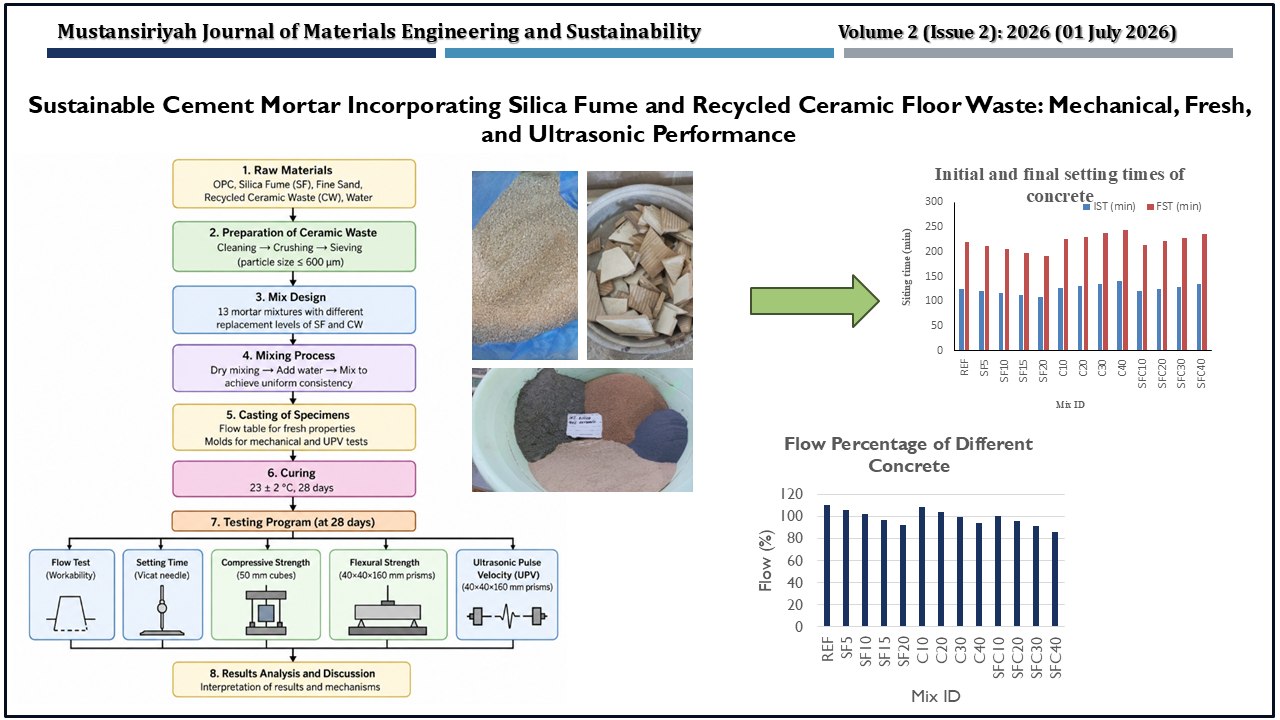
The growing production of industrial by-products and the growing amount of construction and demolition waste have created a range of environmental problems associated with natural resource exhaustion and overburdened landfills. As far as construction and demolition waste is concerned, components such as silica fume and ceramic floor waste have shown some promising features in terms of physical and chemical compatibility with cement-based compositions. The present study focuses on evaluating the effects of using SF as a cement replacement material and CW as a fine aggregate substitute on the performance properties of cement mortar. Altogether, 13 mixes were tested: one control mix, four SF mixes (5%, 10%, 15%, and 20% by weight of cement), four CW mixes (10%, 20%, 30%, and 40% by weight of sand), and four combined SF-CW mixes (10% SF with 10%, 20%, 30%, and 40% CW). Flow tests, setting time determination, compressive strength, flexural strength, and ultrasonic pulse velocity tests were performed, along with scanning electron microscopy. The results showed that the optimal single substitution was 10% SF, reaching a compressive strength of 51.1 MPa, which represents net increase 9 MPa compared to the control specimen (42.1 MPa). The highest compressive (56.1 MPa), flexural (7.5 MPa), and UPV (4.614 km/s) values were observed for the SFC20 composition (10% SF + 20% CW), which indicated a synergetic effect in terms of the density of the material. An increase in both replacements resulted in a decrease in workability.
Downloads
References
[1] B. Lothenbach, K. Scrivener, and R. D. Hooton, "Supplementary Cementitious Materials," Cem. Concr. Res., vol. 41, no. 12, pp. 1244–1256, 2011. https://doi.org/10.1016/j.cemconres.2010.12.001 DOI: https://doi.org/10.1016/j.cemconres.2010.12.001
[2] V. W. Y. Tam, M. Soomro, and A. C. J. Evangelista, "A Review of Recycled Aggregate in Concrete Applications (2000–2017)," Constr. Build. Mater., vol. 172, pp. 272–292, 2018. https://doi.org/10.1016/j.conbuildmat.2018.03.240 DOI: https://doi.org/10.1016/j.conbuildmat.2018.03.240
[3] R. Siddique and M. I. Khan, Supplementary Cementing Materials. Berlin, Germany: Springer, 2011. https://doi.org/10.1007/978-3-642-17866-5 DOI: https://doi.org/10.1007/978-3-642-17866-5
[4] H. Toutanji, N. Delatte, S. Aggoun, R. Duval, and A. Danson, "Effect of Supplementary Cementitious Materials on the Compressive Strength and Durability of Short-Term Cured Concrete," Cem. Concr. Res., vol. 34, no. 2, pp. 311–319, 2004. https://doi.org/10.1016/S0008-8846(03)00253-X DOI: https://doi.org/10.1016/j.cemconres.2003.08.017
[5] S. Bhanja and B. Sengupta, "Influence of Silica Fume on the Tensile Strength of Concrete," Cem. Concr. Res., vol. 35, no. 4, pp. 743–747, 2005. https://doi.org/10.1016/j.cemconres.2004.05.024 DOI: https://doi.org/10.1016/j.cemconres.2004.05.024
[6] A. M. Neville, Properties of Concrete, 5th ed. Harlow, U.K.: Pearson Education, 2011.
[7] R. M. Senthamarai and P. D. Manoharan, "Concrete with Ceramic Waste Aggregate," Cem. Concr. Compos., vol. 27, nos. 9–10, pp. 910–913, 2005. https://doi.org/10.1016/j.cemconcomp.2005.04.003 DOI: https://doi.org/10.1016/j.cemconcomp.2005.04.003
[8] C. Medina, M. I. Sánchez de Rojas, C. Thomas, J. A. Polanco, and M. Frías, "Durability of Recycled Concrete Made with Recycled Ceramic Sanitary Ware Aggregate," Constr. Build. Mater., vol. 31, pp. 112–122, 2012. https://doi.org/10.1016/j.conbuildmat.2011.12.078 DOI: https://doi.org/10.1016/j.conbuildmat.2011.12.078
[9] C. Neno, J. de Brito, and R. Veiga, "Using Fine Recycled Concrete Aggregate for Mortar Production," Mater. Res., vol. 17, no. 1, pp. 168–177, 2014. https://doi.org/10.1590/S1516-14392013005000164 DOI: https://doi.org/10.1590/S1516-14392013005000164
[10] G. Habert, S. A. Miller, V. M. John, J. L. Provis, A. Favier, A. Horvath, and K. L. Scrivener, "Environmental Impacts and Decarbonization Strategies in the Cement and Concrete Industries," Nat. Rev. Earth Environ., vol. 1, pp. 559–573, 2020. https://doi.org/10.1038/s43017-020-0093-3 DOI: https://doi.org/10.1038/s43017-020-0093-3
[11] ASTM International, ASTM C150/C150M-22: Standard Specification for Portland Cement. West Conshohocken, PA, USA: ASTM International, 2022. https://doi.org/10.1520/C0150_C0150M-22. DOI: https://doi.org/10.1520/C0150_C0150M-22
[12] [12] ASTM Int., ASTM C33/C33M-23, "Standard Specification for Concrete Aggregates." West Conshohocken, PA, USA: ASTM Int., 2023. https://doi.org/10.1520/C0033_C0033M-23 DOI: https://doi.org/10.1520/C0033_C0033M-23
[13] ASTM Int., ASTM C1240-20, "Standard Specification for Silica Fume Used in Cementitious Mixtures." West Conshohocken, PA, USA: ASTM Int., 2021. https://doi.org/10.1520/C1240-20 DOI: https://doi.org/10.1520/C1240-20
[14] P. K. Mehta and P. J. M. Monteiro, Concrete: Microstructure, Properties, and Materials, 4th ed. New York, NY, USA: McGraw-Hill Education, 2014.
[15] ASTM Int., ASTM C1602/C1602M-22, "Standard Specification for Mixing Water Used in the Production of Hydraulic Cement Concrete." West Conshohocken, PA, USA: ASTM Int., 2022. https://doi.org/10.1520/C1602_C1602M-22 DOI: https://doi.org/10.1520/C1602_C1602M-22
[16] ASTM Int., ASTM C305-20, "Standard Practice for Mechanical Mixing of Hydraulic Cement Pastes and Mortars of Plastic Consistency." West Conshohocken, PA, USA: ASTM Int., 2020. https://doi.org/10.1520/C0305-20 DOI: https://doi.org/10.1520/C0305-20
[17] ASTM Int., ASTM C191-21, "Standard Test Methods for Time of Setting of Hydraulic Cement by Vicat Needle." West Conshohocken, PA, USA: ASTM Int., 2022. https://doi.org/10.1520/C0191-21. DOI: https://doi.org/10.1520/C0191-21
[18] ASTM Int., ASTM C1437-20, "Standard Test Method for Flow of Hydraulic Cement Mortar." West Conshohocken, PA, USA: ASTM Int., 2019. https://doi.org/10.1520/C1437-20 DOI: https://doi.org/10.1520/C1437-20
[19] ASTM Int., ASTM C109/C109M-21, "Standard Test Method for Compressive Strength of Hydraulic Cement Mortars." West Conshohocken, PA, USA: ASTM Int., 2021. https://doi.org/10.1520/C0109_C0109M-21 DOI: https://doi.org/10.1520/C0109_C0109M-21
[20] ASTM Int., ASTM C348-21, "Standard Test Method for Flexural Strength of Hydraulic-Cement Mortars." West Conshohocken, PA, USA: ASTM Int., 2019. https://doi.org/10.1520/C0348-21. DOI: https://doi.org/10.1520/C0348-21
[21] ASTM Int., ASTM C597-16, "Standard Test Method for Pulse Velocity Through Concrete." West Conshohocken, PA, USA: ASTM Int., 2016. https://doi.org/10.1520/C0597-16 DOI: https://doi.org/10.1520/C0597-16
[22] H. Y. Qasrawi, "Concrete Quality In Situ Using the Rebound Number and the Ultrasonic Pulse Velocity," Constr. Build. Mater., vol. 14, nos. 6–7, pp. 363–369, 2000. https://doi.org/10.1016/S0950-0618(00)00028-6
[23] G. Mármol, S. F. Santos, H. Savastano, M. V. Borrachero, J. Monzó, and J. Payá, "Mechanical and Physical Performance of Low Alkalinity Cementitious Composites Reinforced with Recycled Cellulosic Fibres from Cement Kraft Bags," Ind. Crops Prod., vol. 49, pp. 422–427, 2013. DOI: https://doi.org/10.1016/j.indcrop.2013.04.051
[24] V. G. Papadakis, "Experimental Investigation and Theoretical Modeling of Silica Fume Activity in Concrete," Cem. Concr. Res., vol. 29, no. 1, pp. 79–86, 1999. https://doi.org/10.1016/S0008-8846(98)00171-9 DOI: https://doi.org/10.1016/S0008-8846(98)00171-9
Downloads
Published
Issue
Section
Categories
License
Copyright (c) 2026 Rafla Abbas Abduljabbar, Dalia Adil Dalia Adil Rasool (Author)

This work is licensed under a Creative Commons Attribution 4.0 International License.
Open Access and Copyright
MJMES follows an open-access publishing model, ensuring that all published articles are freely accessible to a global audience without any subscription or payment barriers. Every article is distributed under the Creative Commons Attribution International Public License (CC BY 4.0), which grants broad rights to individuals and institutions, allowing them to:
- Download, share, and distribute full-text articles without restrictions.
- Print, reproduce, or link to published content in any format or medium.
Although copyright ownership remains with the authors, MJMES actively promotes their work by facilitating citation tracking and visibility, thereby enhancing the impact and recognition of published research. The CC BY 4.0 license is designed to maximize the reach and reuse of scholarly publications while ensuring that appropriate credit is always attributed to the original authors.
How to Cite